Introduction
This tutorial will walk you through the complete process of building a case profile for an appellate court case. We'll use the case of Coffeyville Resources Refining & Marketing, LLC v. EPA as our example.
In this guide, you'll learn how to:
- Navigate between different legal databases
- Verify you have the correct case
- Extract key information from court documents
- Build a comprehensive chronological case profile
- Use AI tools to clarify complex legal arguments
1Initial Case Review
I opened the web app and clicked on one of Hanna's cases, discovering it at the same time as I'm documenting this process.
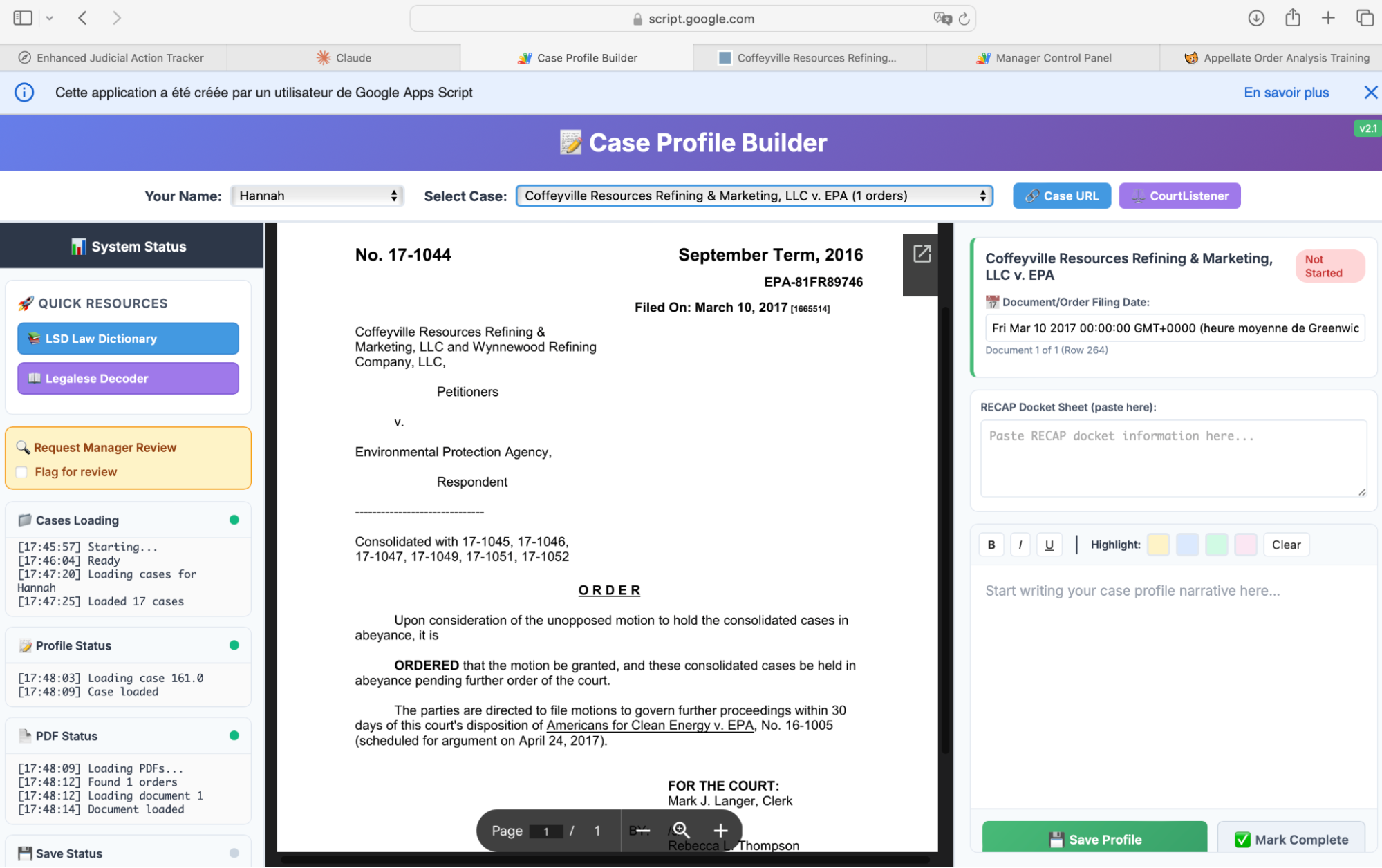
Initial view of the case in the web application
Before doing anything else, I check the date shown in the PDF: March 10, 2017. The date on the right panel appears correct, and the case title matches as well. Good! No need to make any corrections at this point.
Initial Case Profile Entry
2Retrieving the RECAP Docket Sheet
Before continuing, I need to retrieve the RECAP docket sheet. This requires clicking on the CourtListener link, which takes me to the RECAP website.
How to Access RECAP:
Step 1: First, I copy the name of the case:
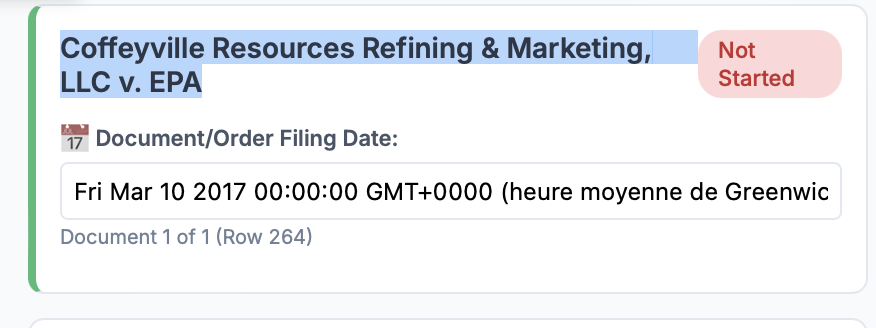
Copying the case name from the web app
Step 2: Then, I click on Court Listener:
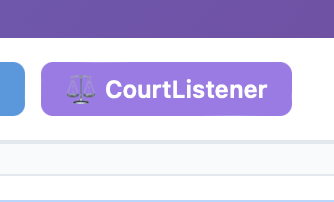
The Court Listener button location
Step 3: After clicking, it opens a new tab in my browser:
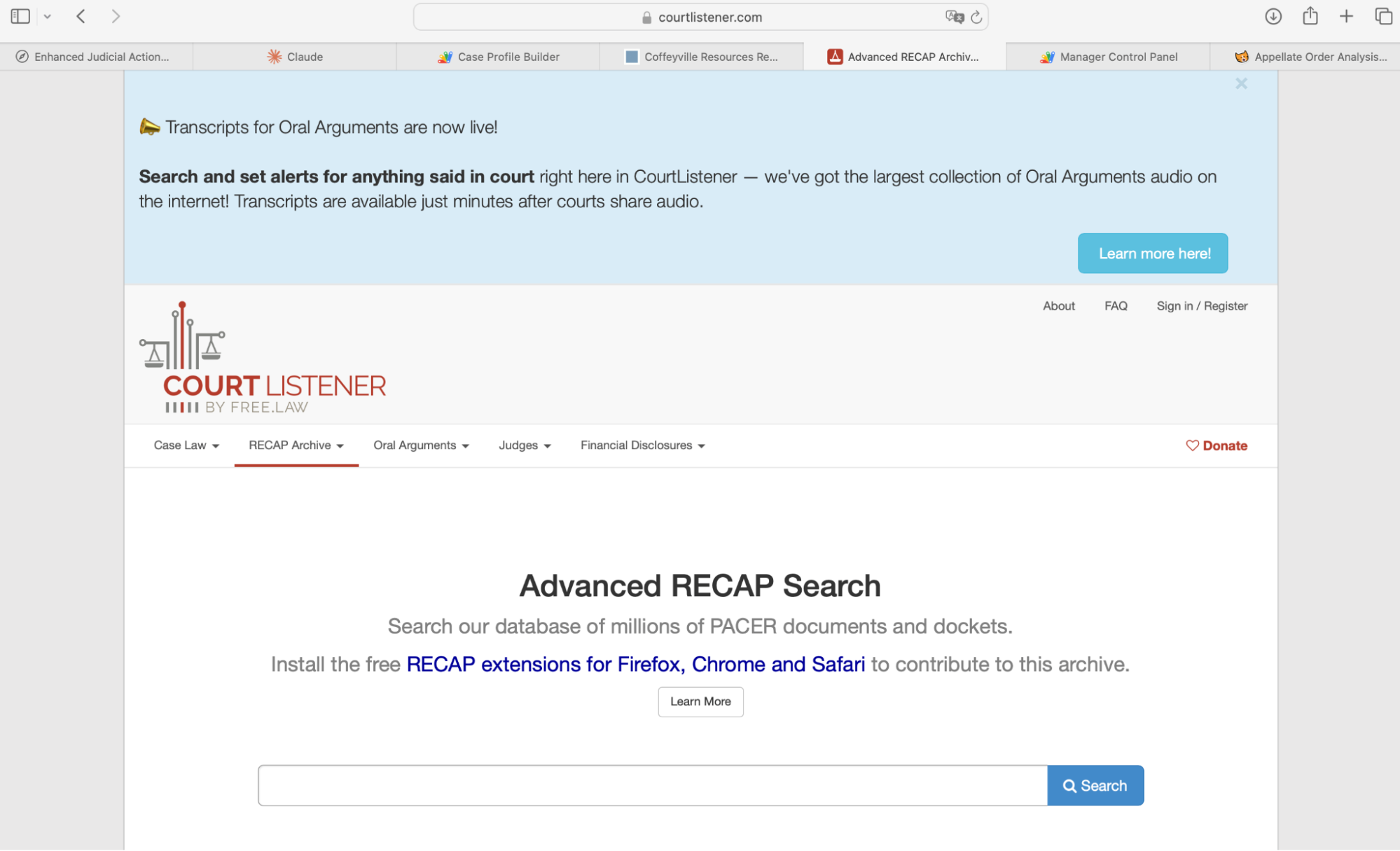
RECAP website homepage
Step 4: Now I paste the case name in the search tool:

Pasting the case name into RECAP search
3Verifying the Correct Case
Here's what I get from the search:
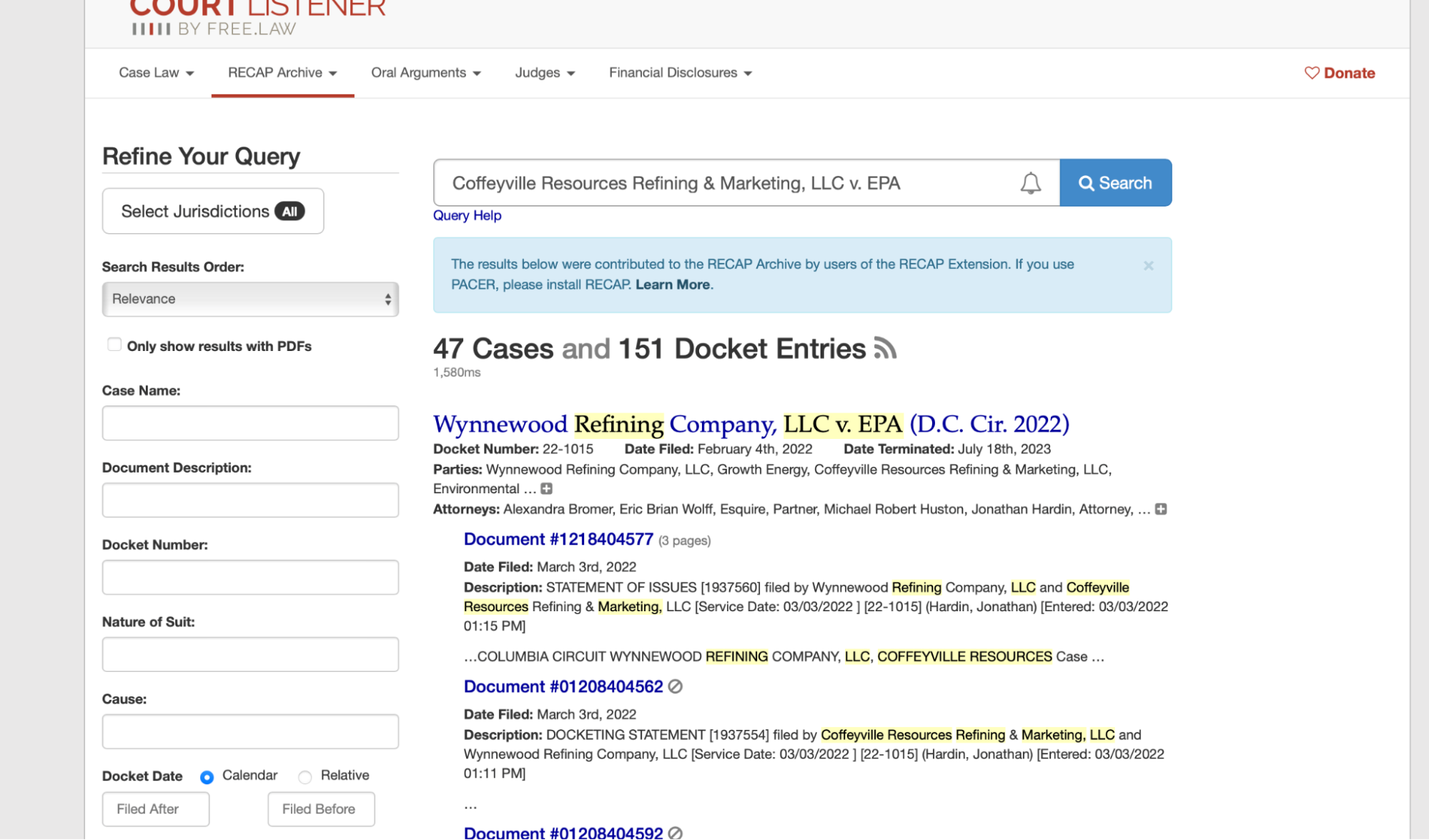
Initial RECAP search results
Let me go back to the PDF and check for clues. When I return to the webapp, I see that the petitioner is indeed Coffeyville Resources Refining and Marketing LLC and Wynnewood Refining Company.
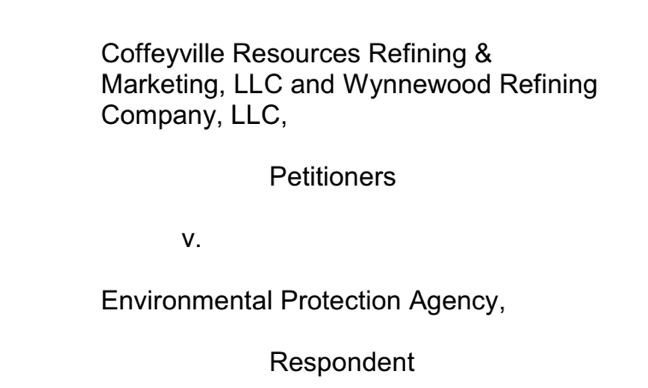
Confirming the petitioner information
And EPA is indeed the respondent. The court that heard the case, shown at the top of the document, is the DC Circuit (District of Columbia Circuit):
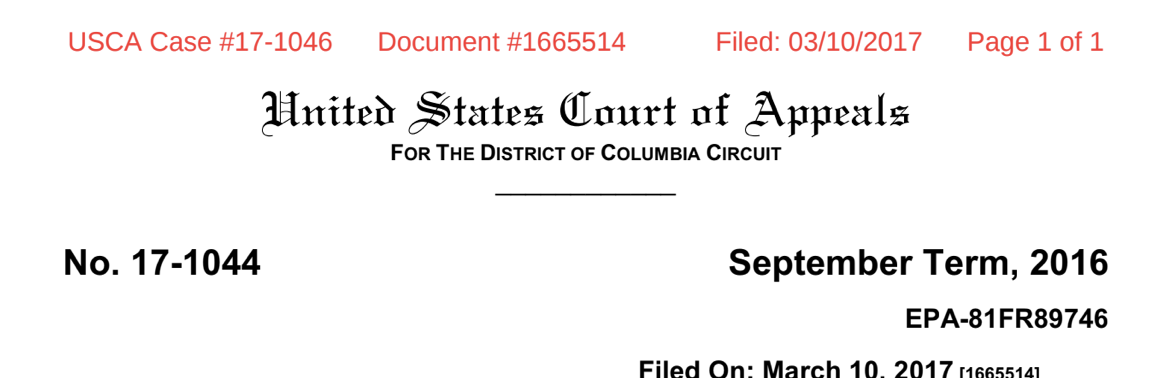
Verifying the court - DC Circuit
So it seems like the case I found on RECAP (the first one that appeared) might be the right one, but we're not sure yet. We need to make sure it's indeed the correct case.
Opening the Case URL
To verify, I'll open the case URL from the web app:
Clicking the case URL button
This takes me to the Sabin Center Climate Case Chart:
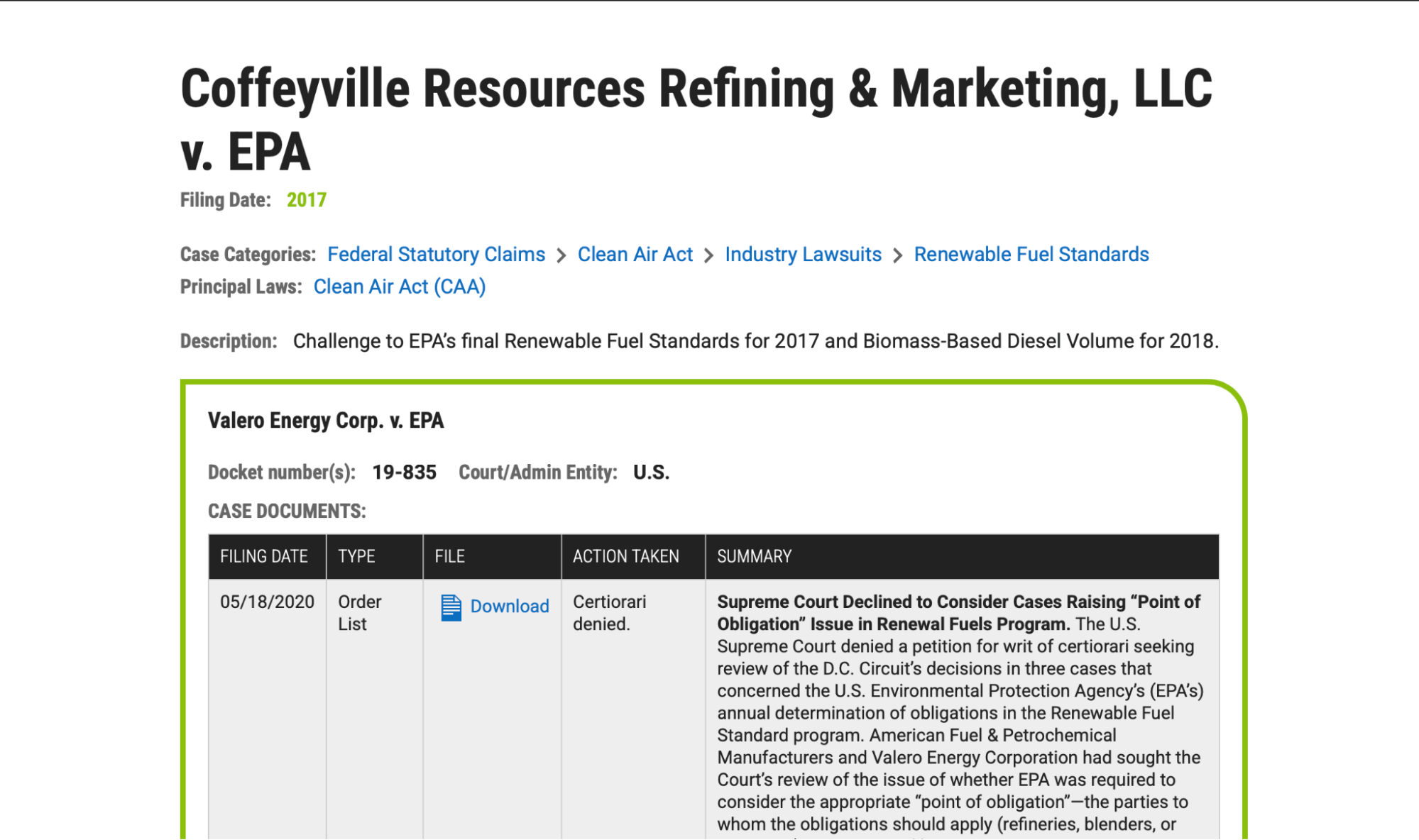
Case details page on Sabin Center database
Something's strange though - by scrolling down, I don't see any dates from 2017 in the first case listed. The latest I found is from 2020, but it's in the US Court Admin (which means the Supreme Court). Remember, we're looking at appellate/circuit court cases, so that's not even the right court.
However, scrolling down, I do see the Coffeyville Resources Refining and Marketing LLC v. EPA case (they're likely related to the US Supreme Court case):
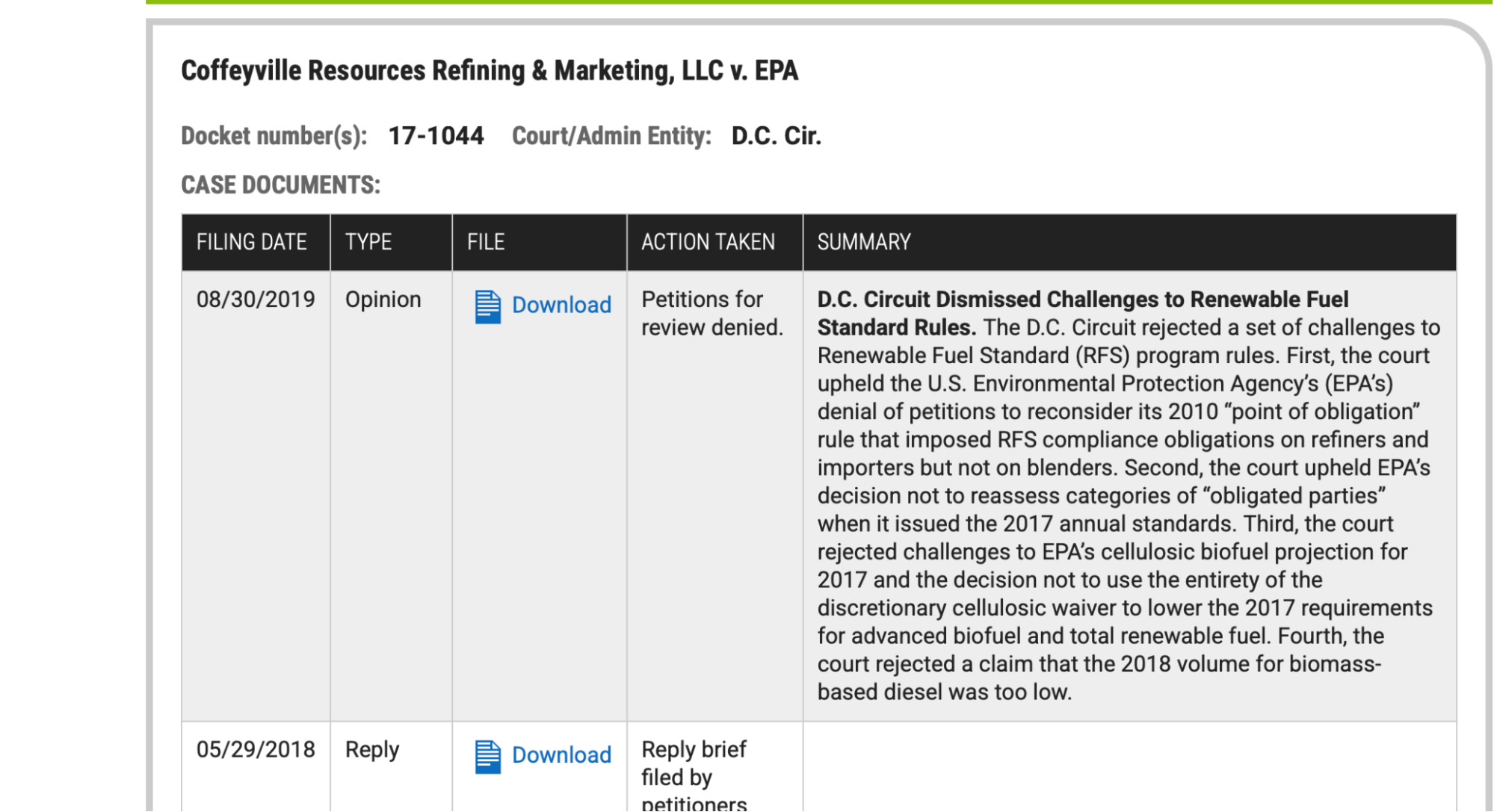
Finding related cases in the database
Sadly, the latest document recorded is from 2019. Something's wrong with this RECAP entry:
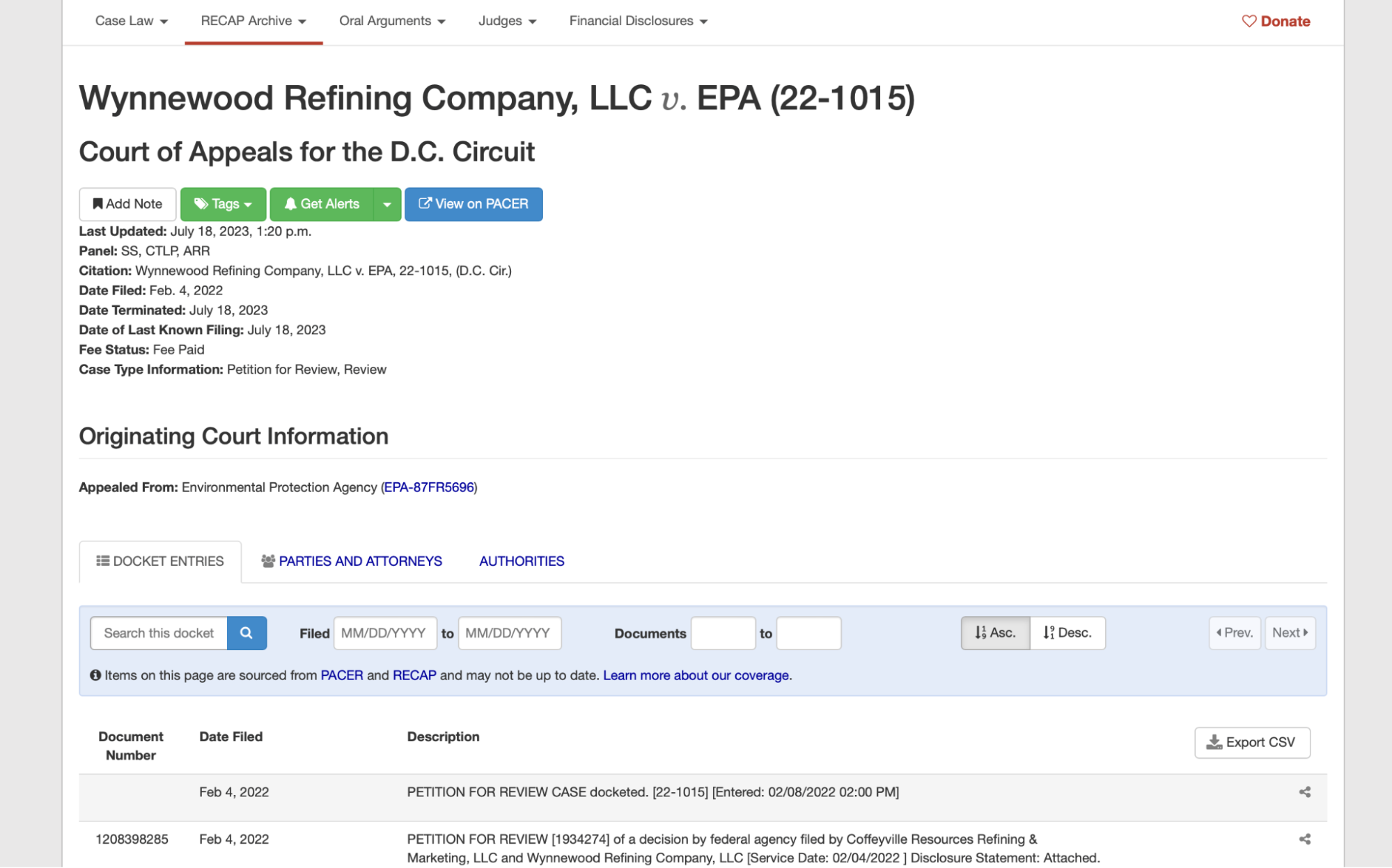
Incorrect dates - this isn't our case
Finding the Correct Case
I scrolled down and the third case on RECAP that's listed seems to be one that started in 2017! Precisely on February 9, 2017, with a petition for review by Coffeyville:
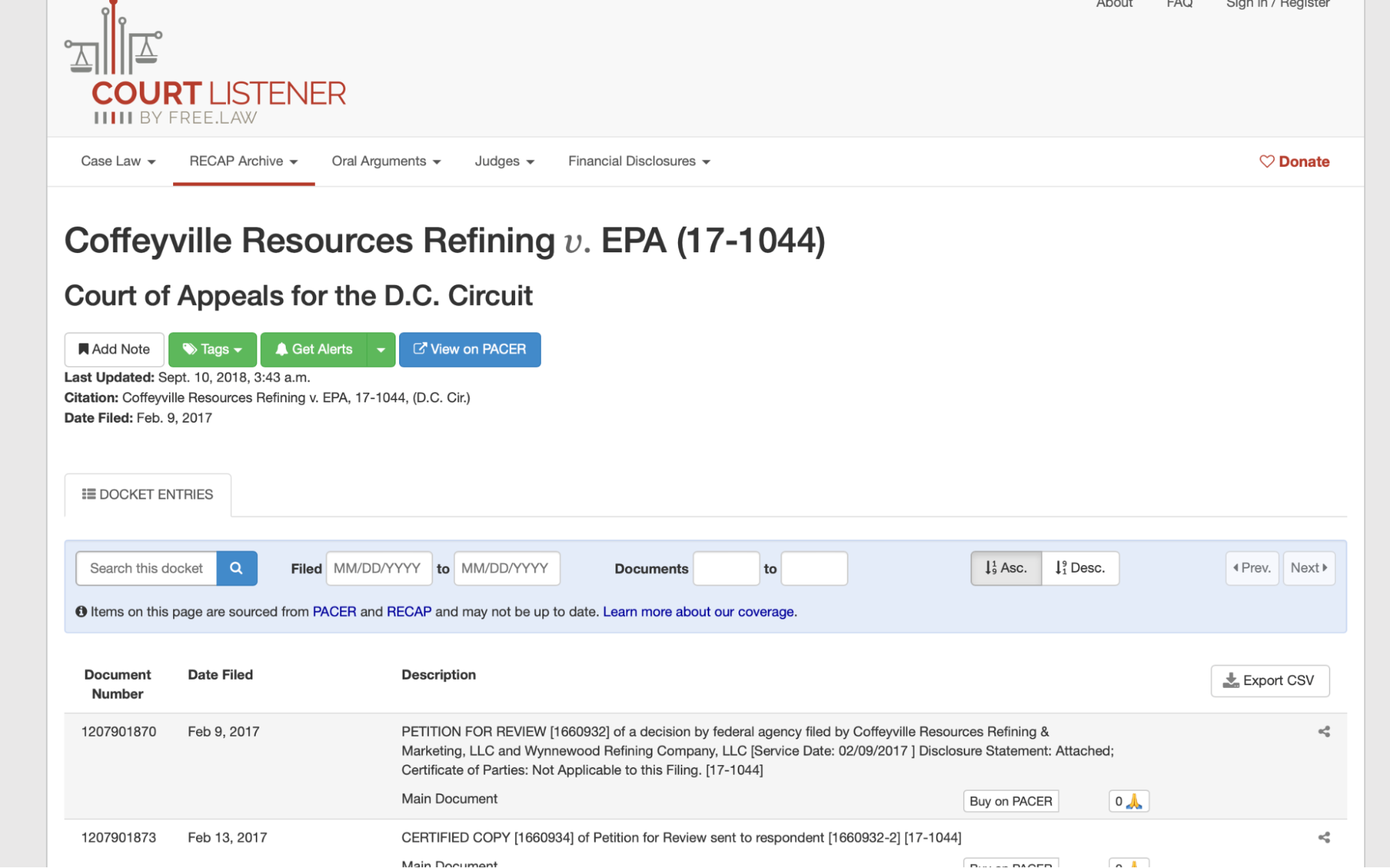
Found the correct case - February 9, 2017
Let's check if it's the right one. I'll go back to the case URL and look for a petition for review at that date, and... BINGO!
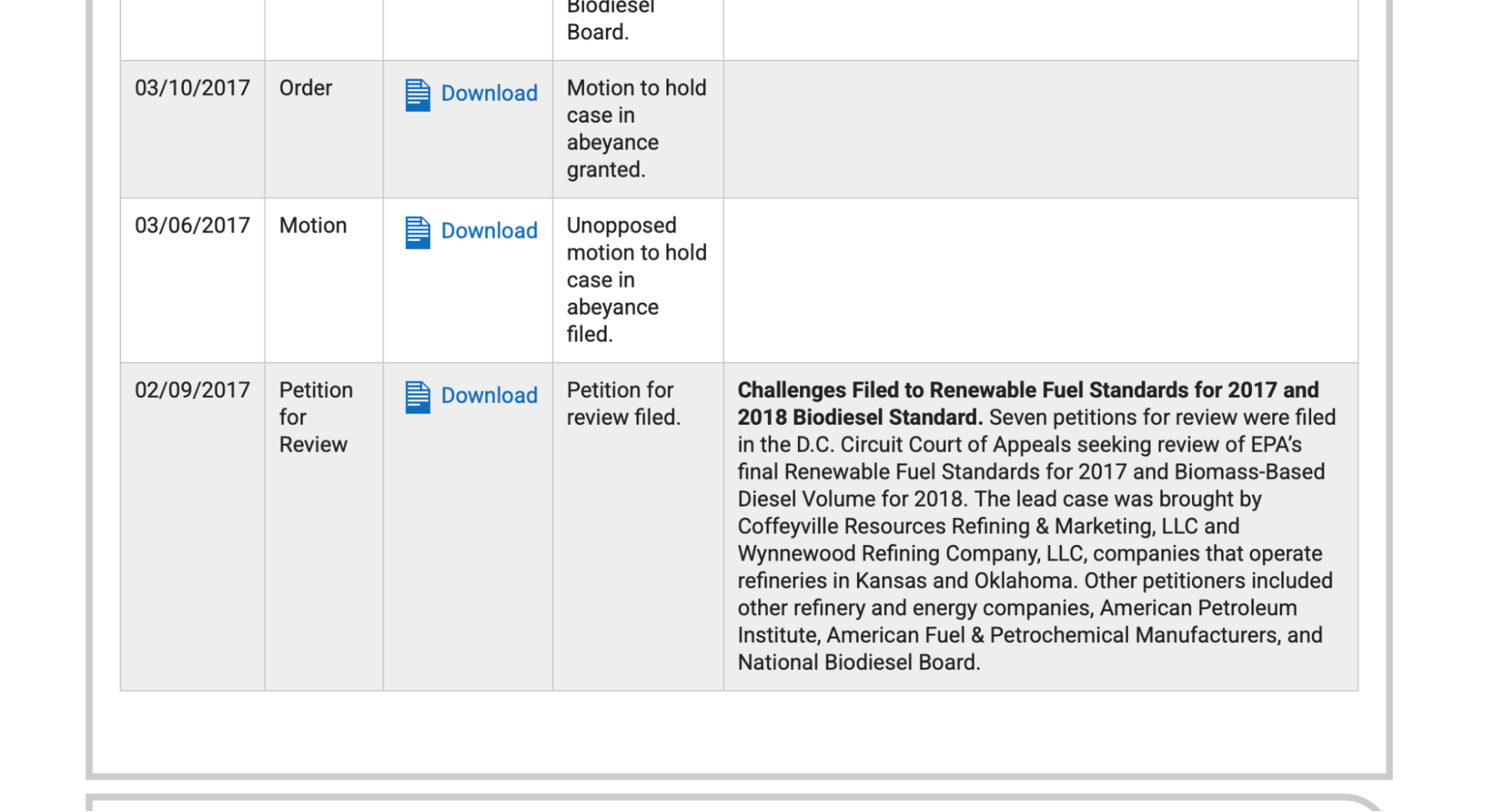
February 9, 2017 - Perfect match!
February 9, 2017! That's the one. I can double-check this way: when clicking on the petition for review download button which opens a new tab, I see Case No. 17-1044:
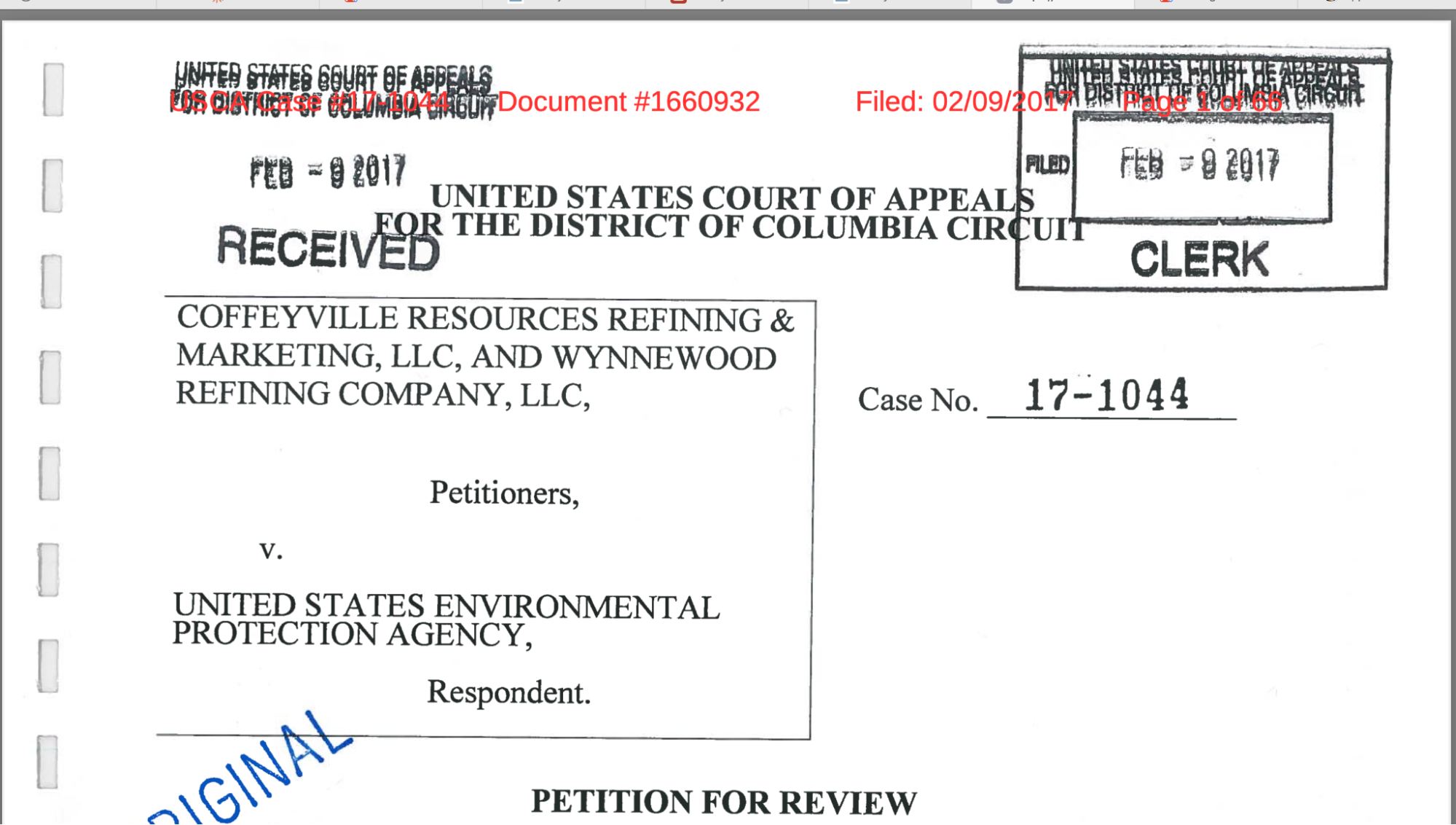
Verifying case number 17-1044
And the same appears on RECAP:
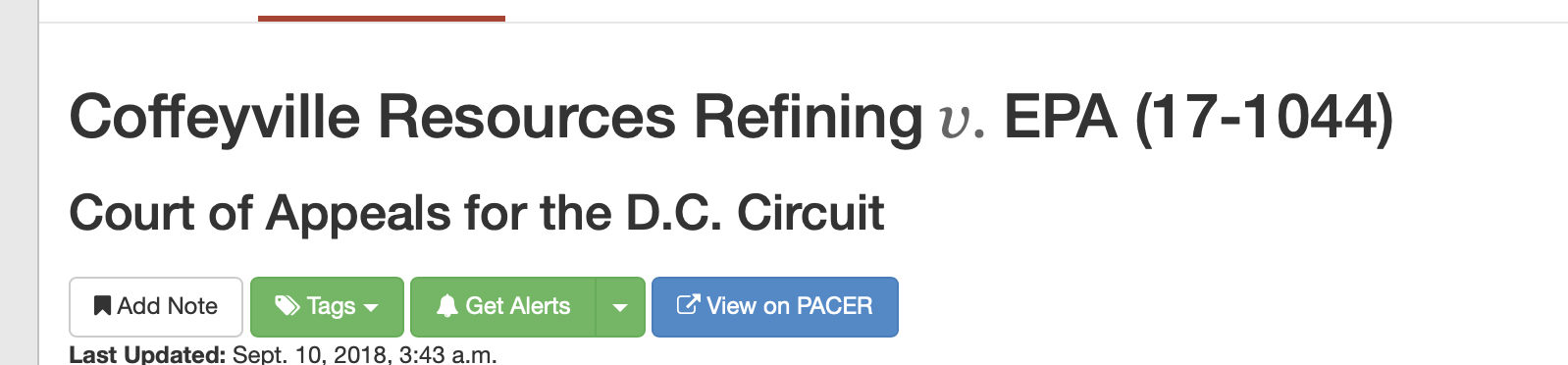
Matching case number on RECAP
Understanding the Sabin Center Tables
Please don't get confused by the tables on Sabin Center - they can be messy! They show case history in multiple jurisdictions, and since multiple petitions for review are often filed, it only takes one of them as the initiation of the case.
When I looked for that petition for review, I saw this:
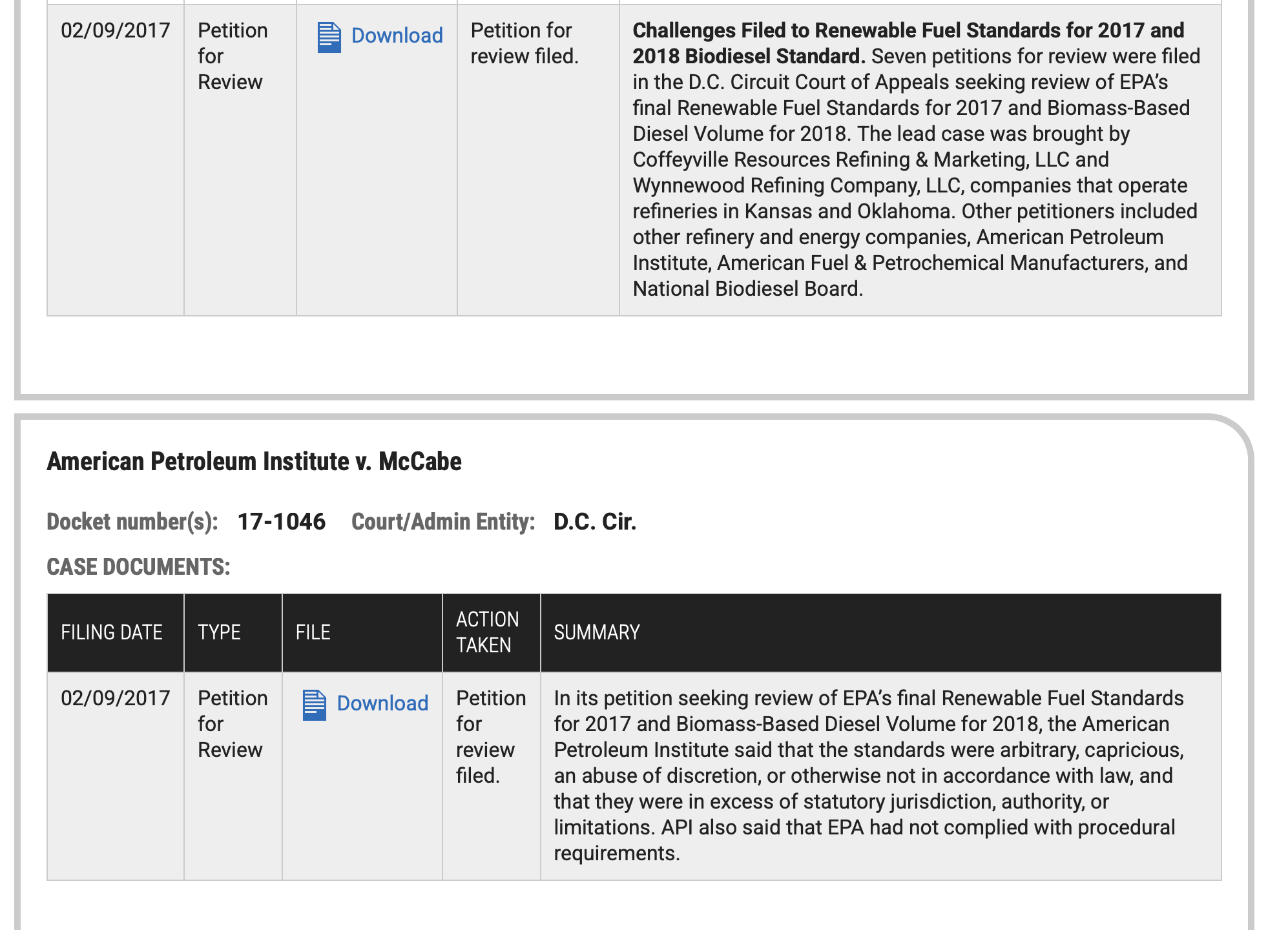
Multiple petition entries - part 1
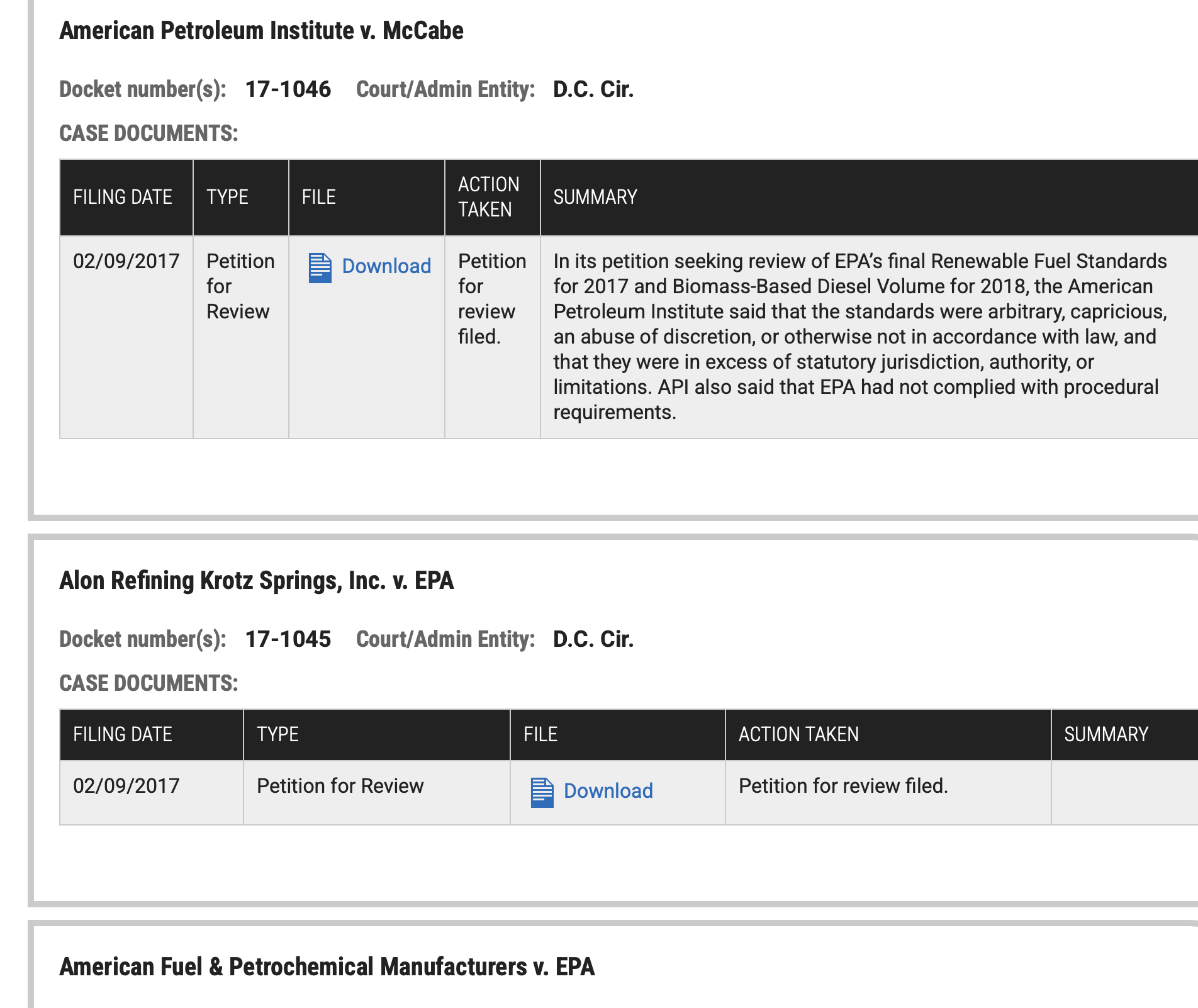
Multiple petition entries - part 2
And others when scrolling down. This is fine! They're confusing but they're just other petitions for review against the same decision that case number 17-1044 also petitioned against.
4Copying the RECAP Docket Sheet
Now, on the RECAP page, I copy-paste the entire docket sheet (the table with the motions):
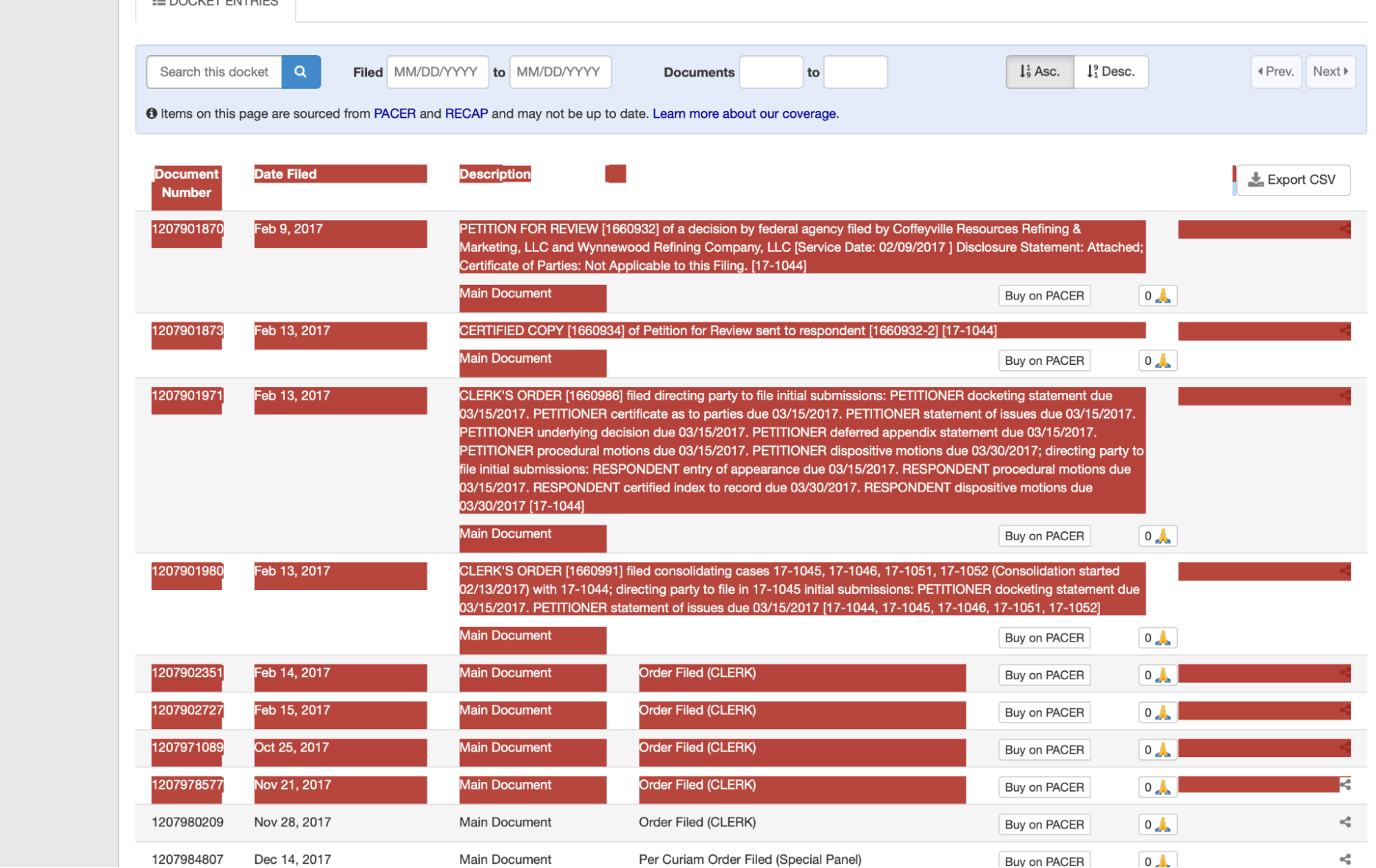
Selecting and copying the RECAP docket sheet
I keep going until the last action:
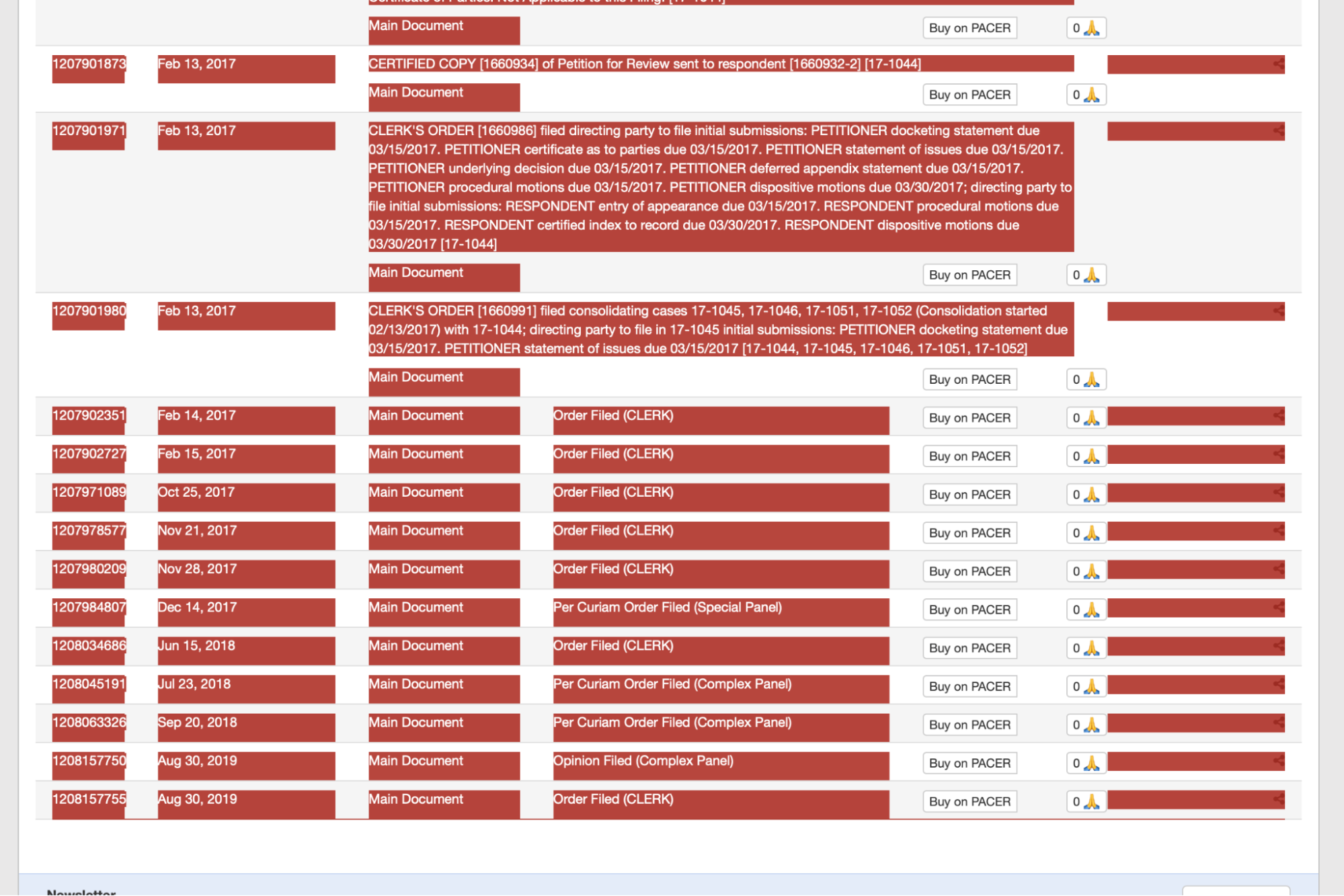
Copying through to the last recorded action
Once copied, I paste it into the webapp where it says "RECAP docket sheet":
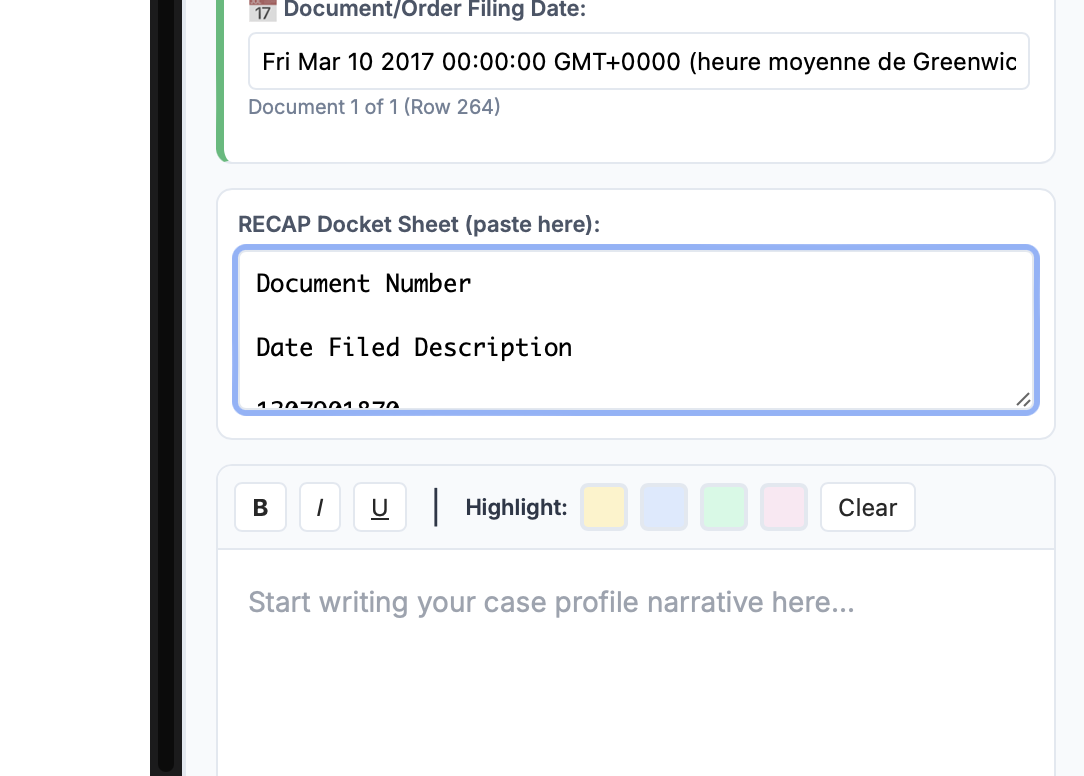
Pasting the docket sheet into the web app
5Building the Case Profile - First Order Analysis
Let's look at the order:
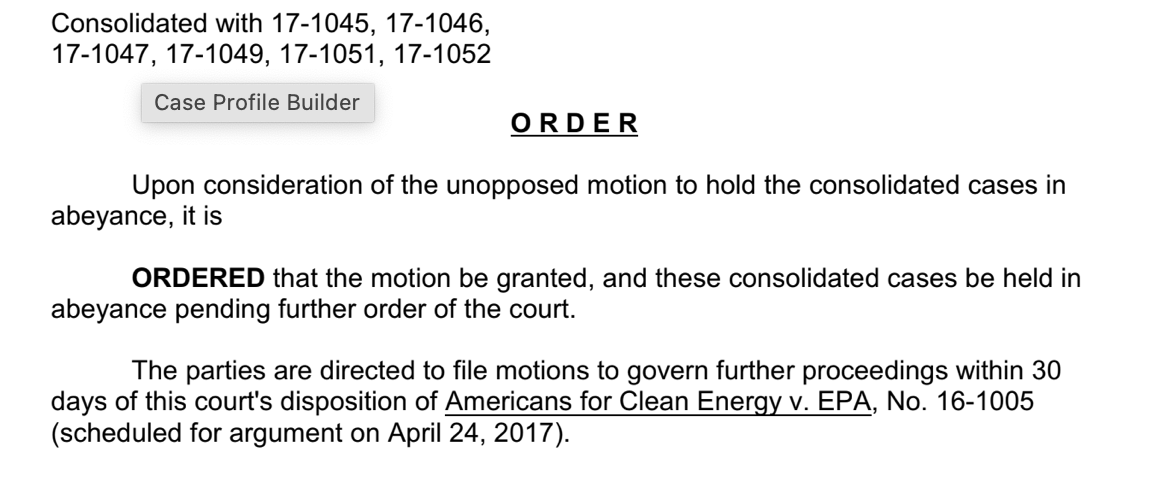
Examining the first order
I see multiple things here:
- There was a motion filed (by whom? I don't know yet) to hold the consolidated cases in abeyance
- It was granted
Identifying Case Consolidation
I also see that cases were consolidated. The judges consolidated cases together, specifically cases 17-1045, 46, 47, 49, 51, and 52:
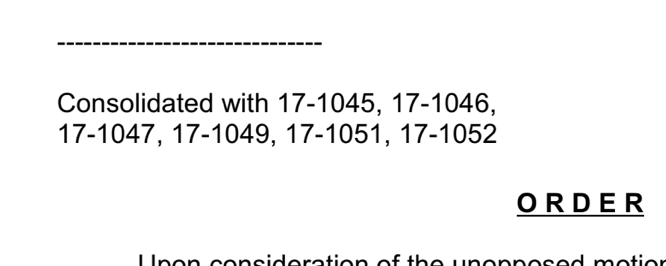
List of consolidated case numbers
Since cases need to be consolidated, there must be multiple cases. This means multiple parties likely filed petitions for review. So I'll add placeholders for these:
Additional Order Details
Finally, from this order I also see that judges are directing all parties to file motions to govern further proceedings within 30 days of the court's disposition of another case, Case No. 16-1005:

Directive to file motions within 30 days
6Finding Missing Documents
This is the only order available in my database, so a lot of information is missing. Let's go to the case URL and try to find the order of March 10, 2017, to see if there are documents before that could help us build something more informative and complete.
I click again on case URL, and... FOUND IT!

Located the March 10, 2017 order
Now what's next? Well look, just under it I see:
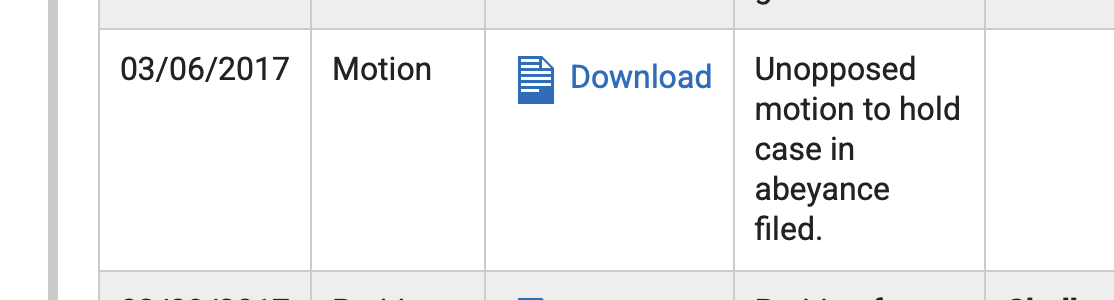
Motion to hold case in abeyance
That's a motion filing! That's the party who filed the motion we talked about earlier, to hold the case in abeyance! Let me check who filed it:
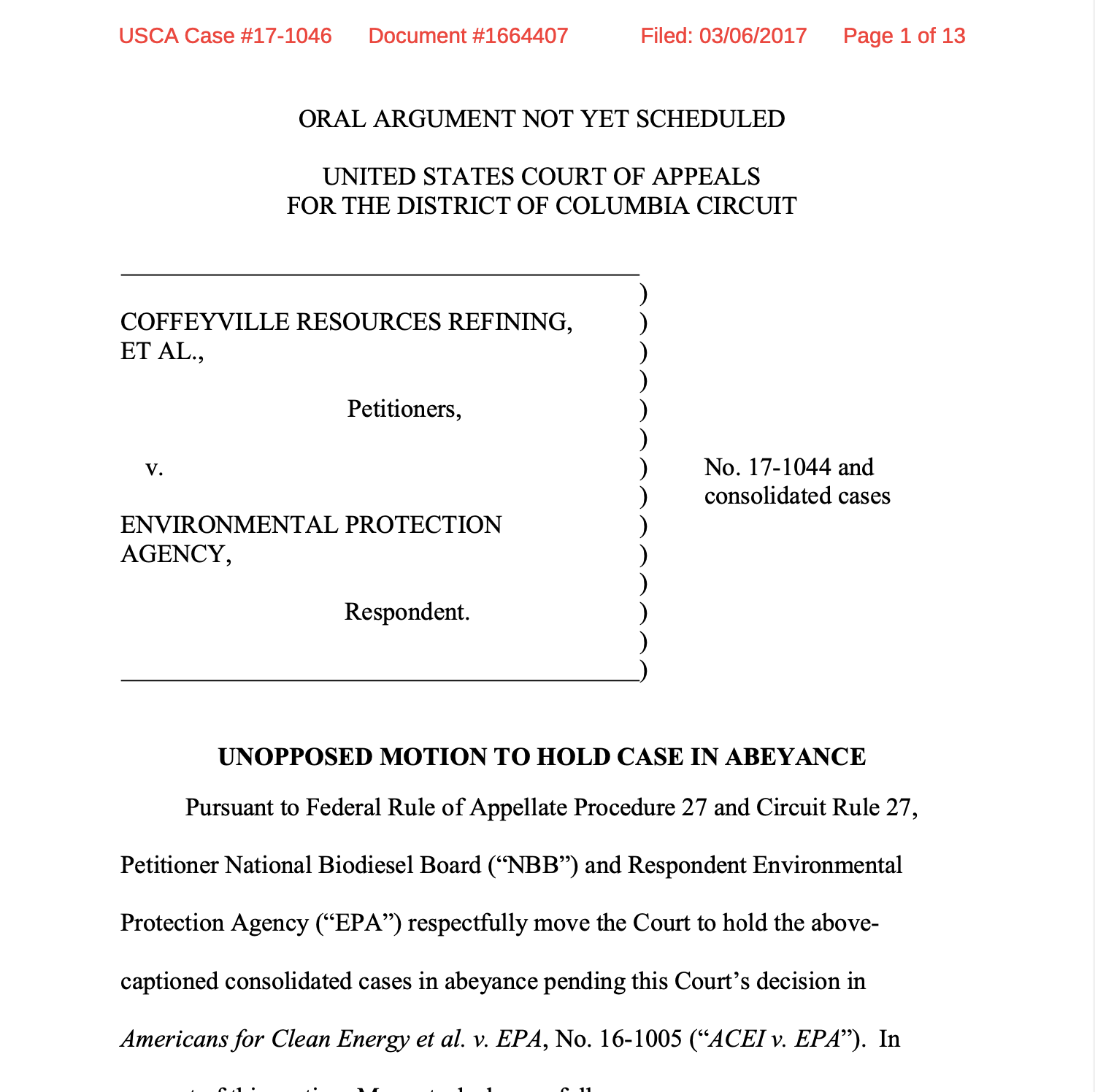
Examining motion details
I don't see exactly who filed the motion, but I see that "Petitioner National Biodiesel Board and EPA, the respondent, respectfully 'move' (i.e., file a motion) to hold the case in abeyance." So maybe both of them filed it? But then shouldn't it be a joint motion rather than just an unopposed motion? Let's check who submitted the document by looking at the counsel section:
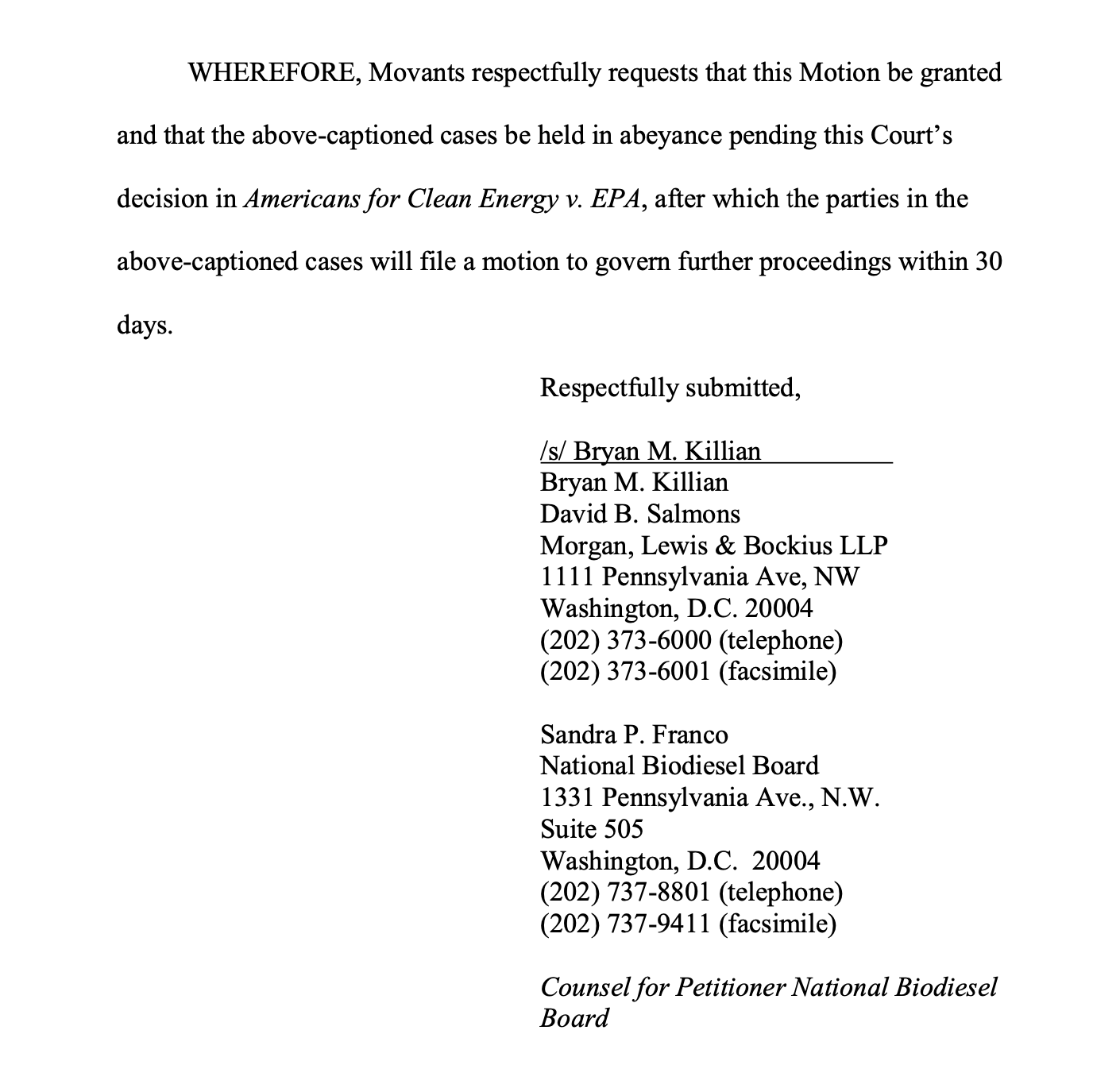
Counsel for petitioner
There's both counsel for petitioner and...
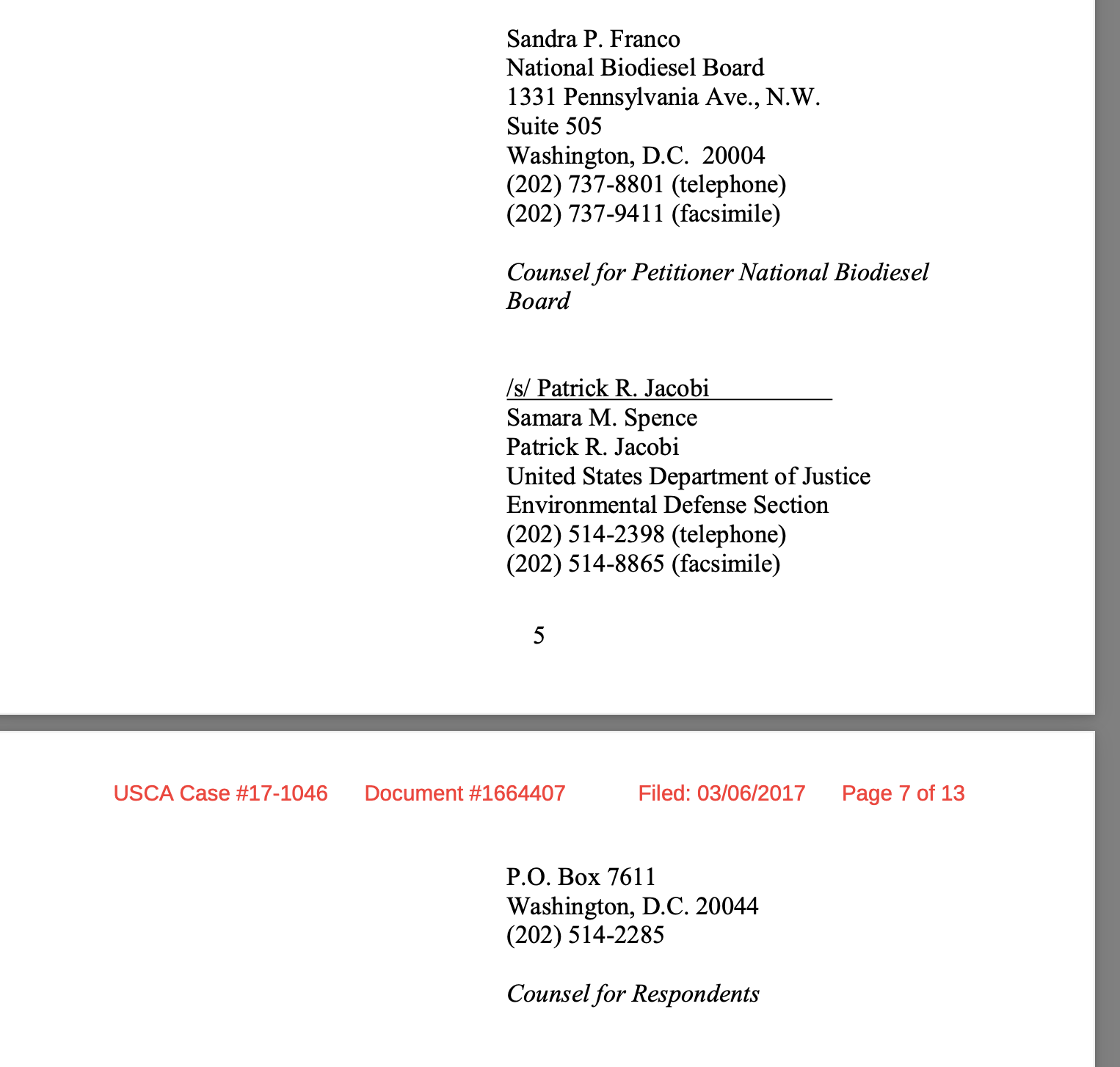
Counsel for respondent
And for respondents! So I'd say it's a joint motion (which is obviously unopposed, since it's filed together).
Finding Party Information
Even better! In that same document, I find a section called CERTIFICATE AS TO PARTIES, RULINGS UNDER REVIEW AND RELATED CASES:
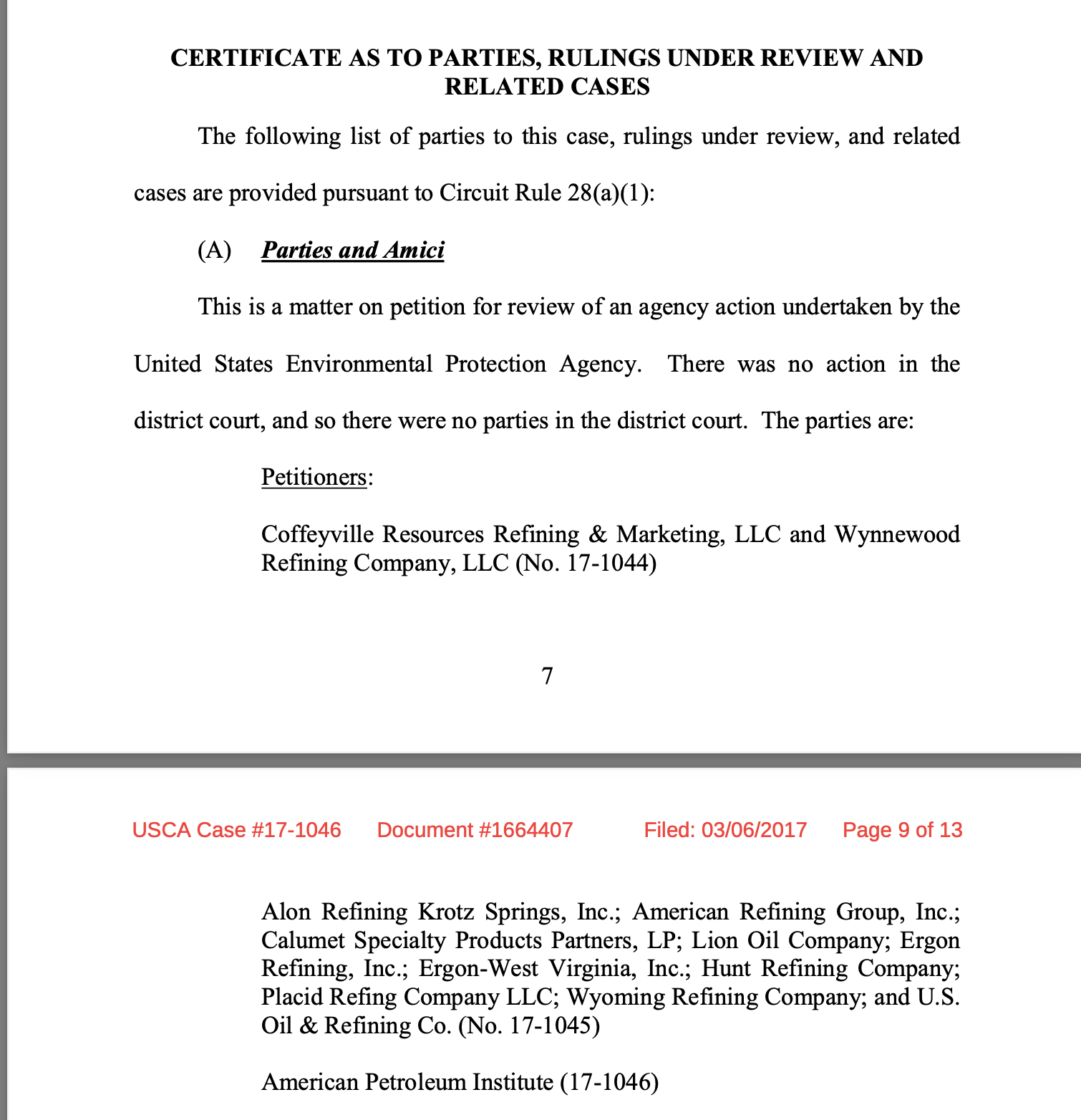
Certificate of parties - part 1
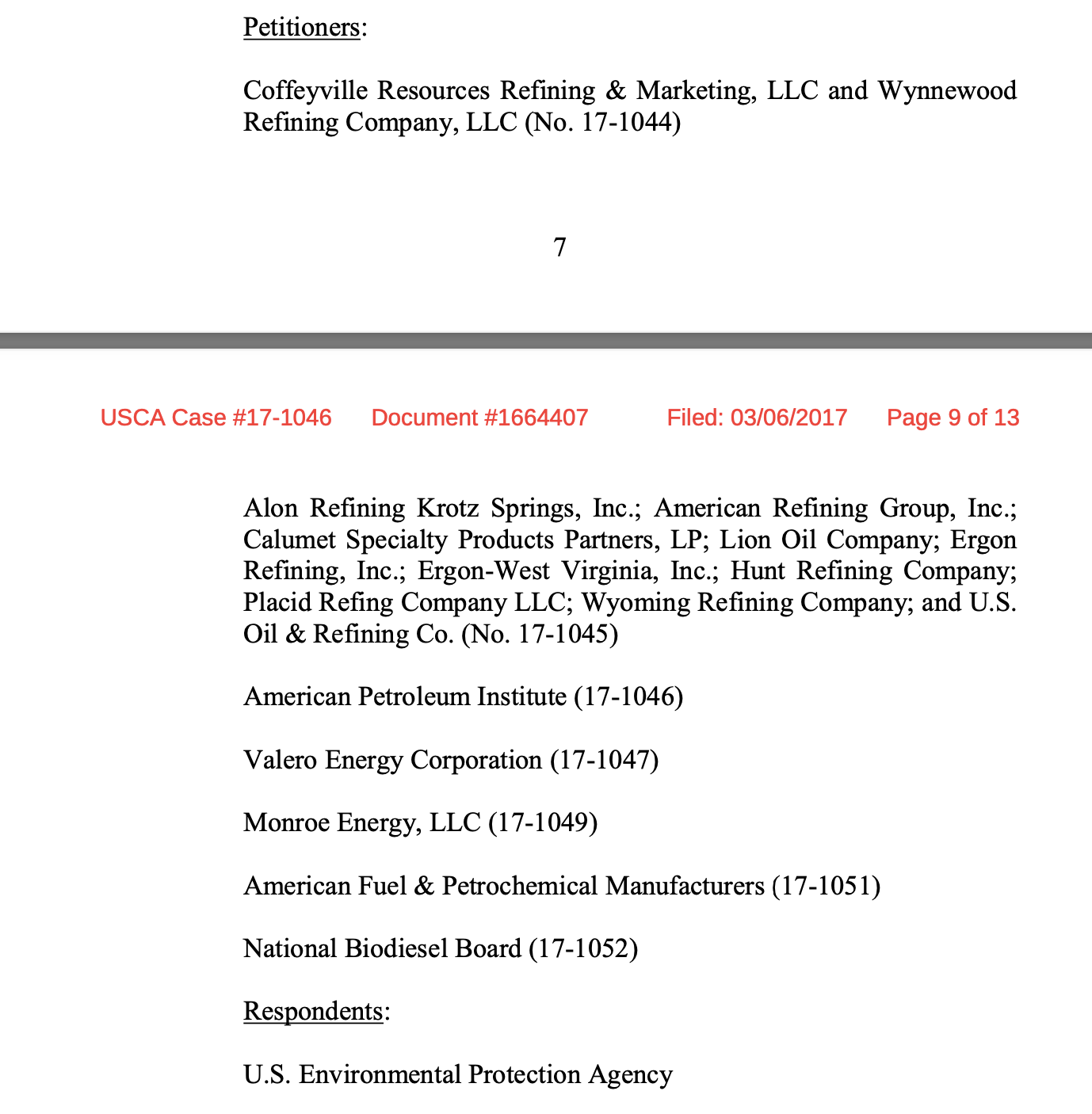
Certificate of parties - part 2
It literally tells me who the petitioners are for each initiating case! This is extremely useful. I also found this under Section A on parties involved, which shows the agency decision being challenged:
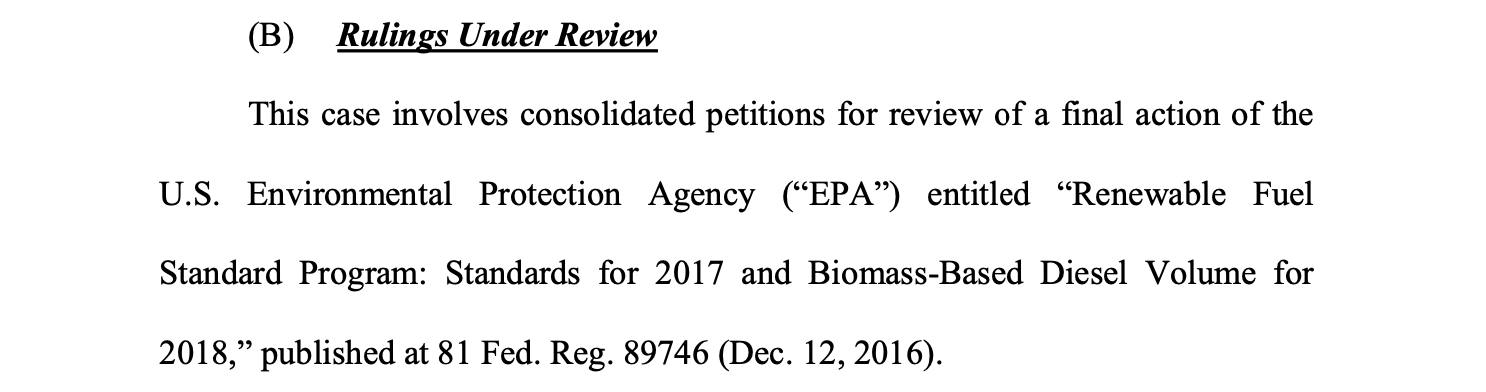
The EPA rule being challenged
7Understanding Motions to Intervene
Looking at what happens after March 6, 2017:
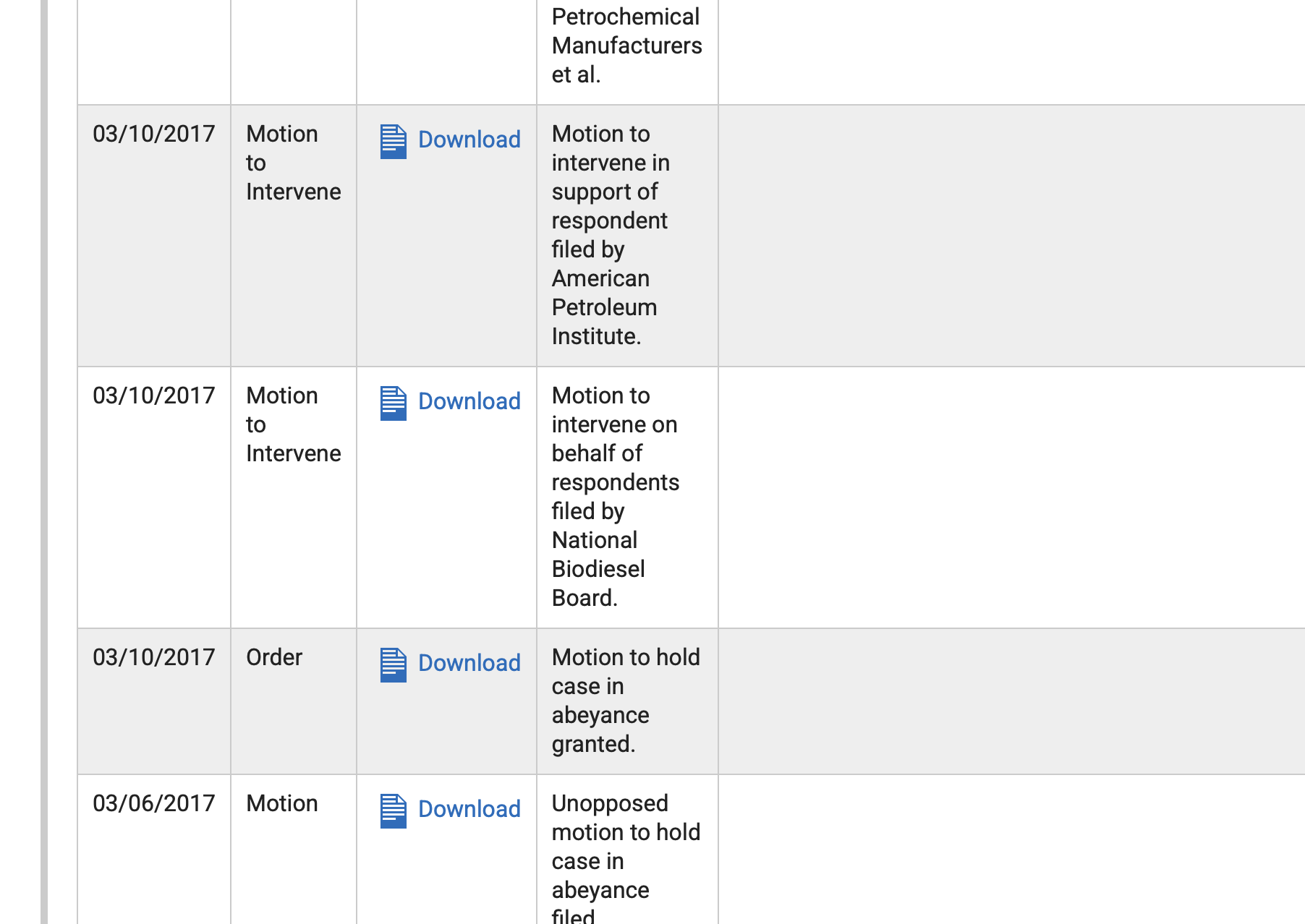
Motions to intervene filed on March 10, 2017
I see there are some motions to intervene here! But it's strange because it says the motion to intervene on March 10 is filed by the National Biodiesel Board... But they're the ones who filed the motion to hold the case in abeyance on March 6! How can they intervene in a case where they're already a party (petitioner)? That doesn't make sense.
I found the answer on page 3 of the document:
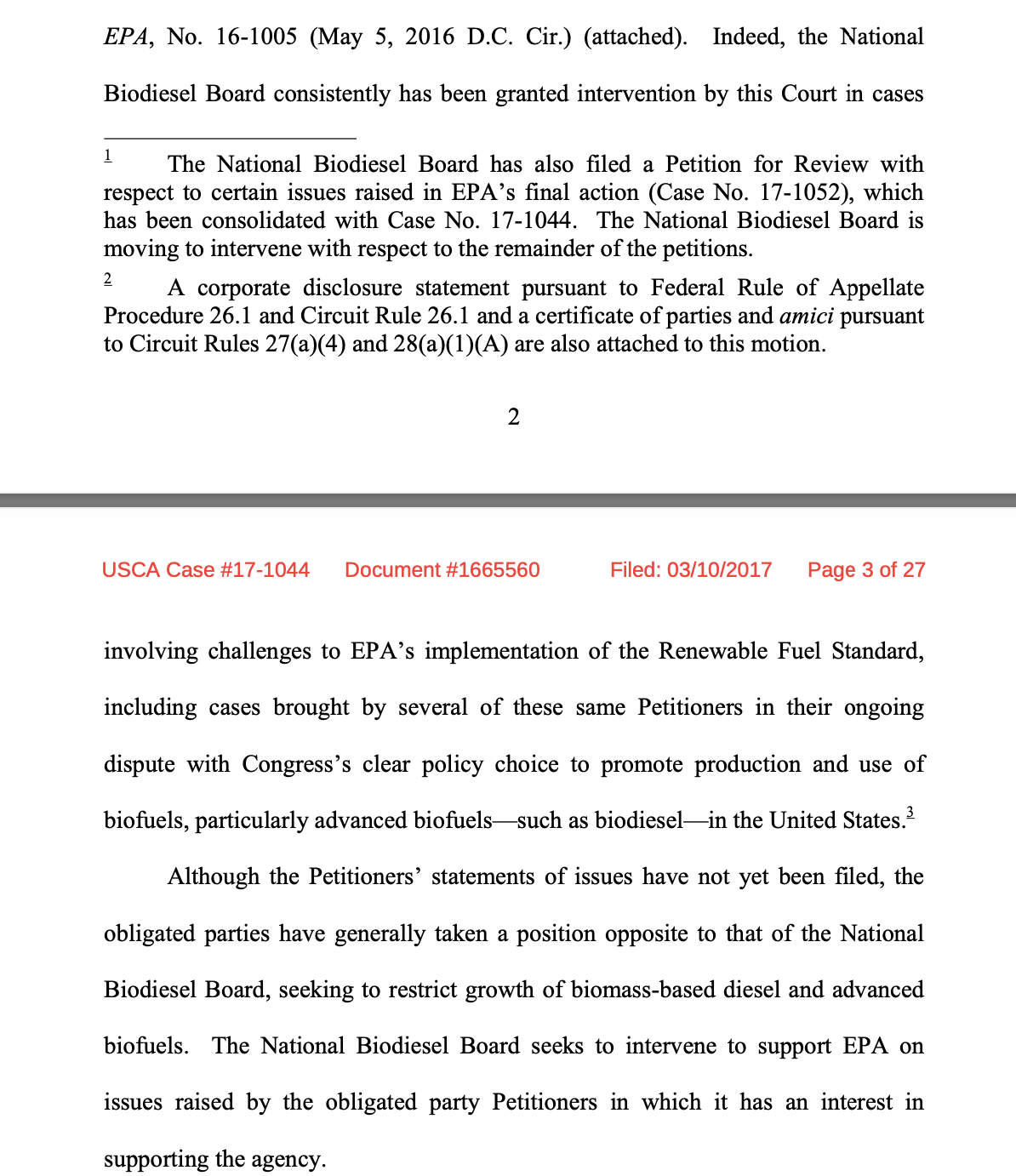
NBB's explanation for intervention
It says that indeed they filed a petition for review (page 2, footnote 1) but then it states: "Although the petitioners' statement of issues have not yet been filed, the obligated parties have generally taken a position opposite to that of the National Biodiesel Board."
Basically, they're saying: "I was a petitioner but others are not serving my interests and actually want to side with EPA." They "seek to intervene to support EPA on issues raised by the obligated party Petitioners in which it has an interest in supporting the agency." Now we know that NBB is supporting EPA at this stage!
American Petroleum Institute Motion
Similarly, the American Petroleum Institute filed a motion to intervene to support respondent (EPA):
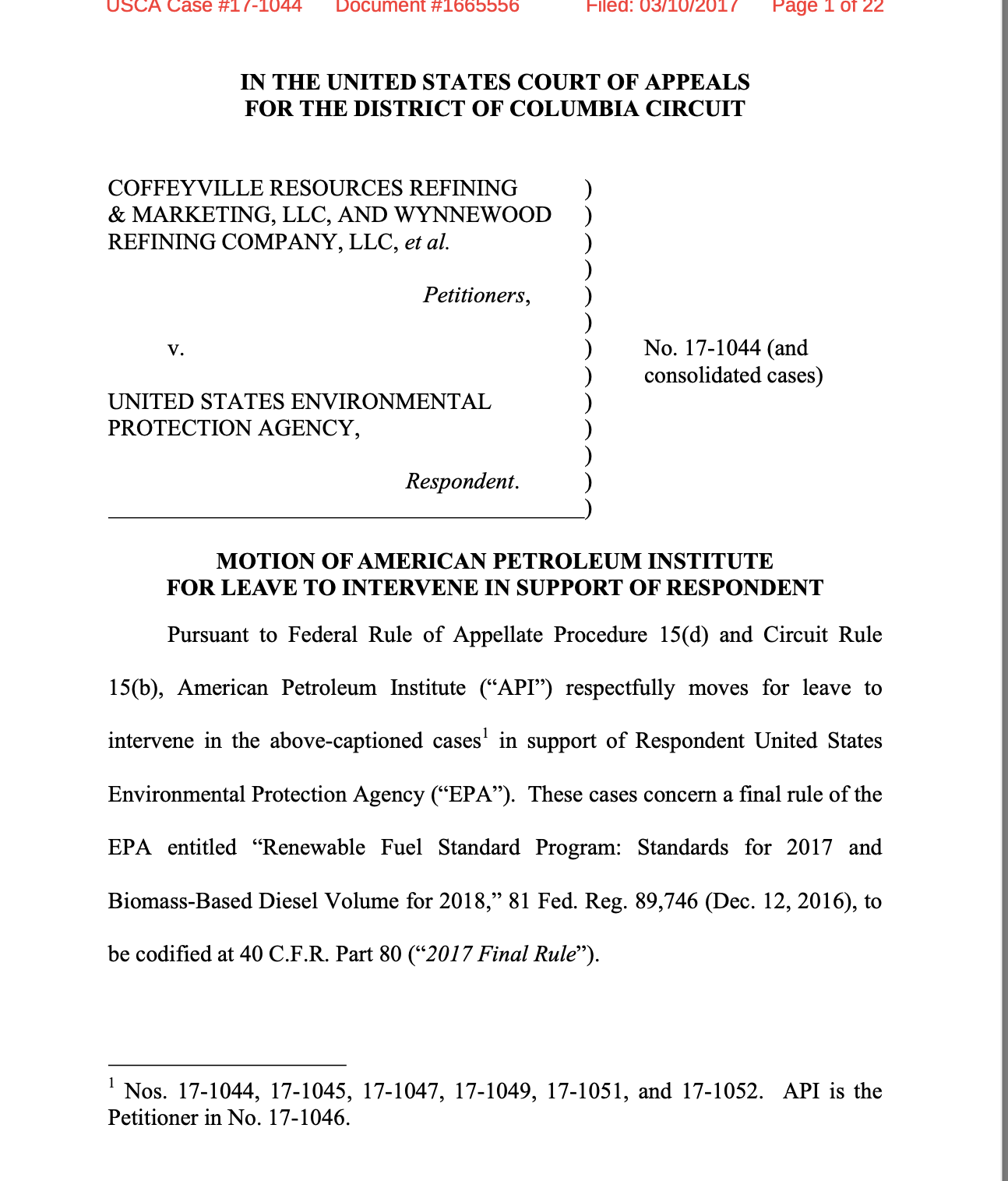
API motion to intervene
Looking at footnote 1, it says API is petitioner in No. 17-1046. They did the same as NBB - they state they "move for leave to intervene in the above-captioned case in support of respondent EPA," even though they were a petitioner before.
I also found that no one has taken a position on this motion to intervene:
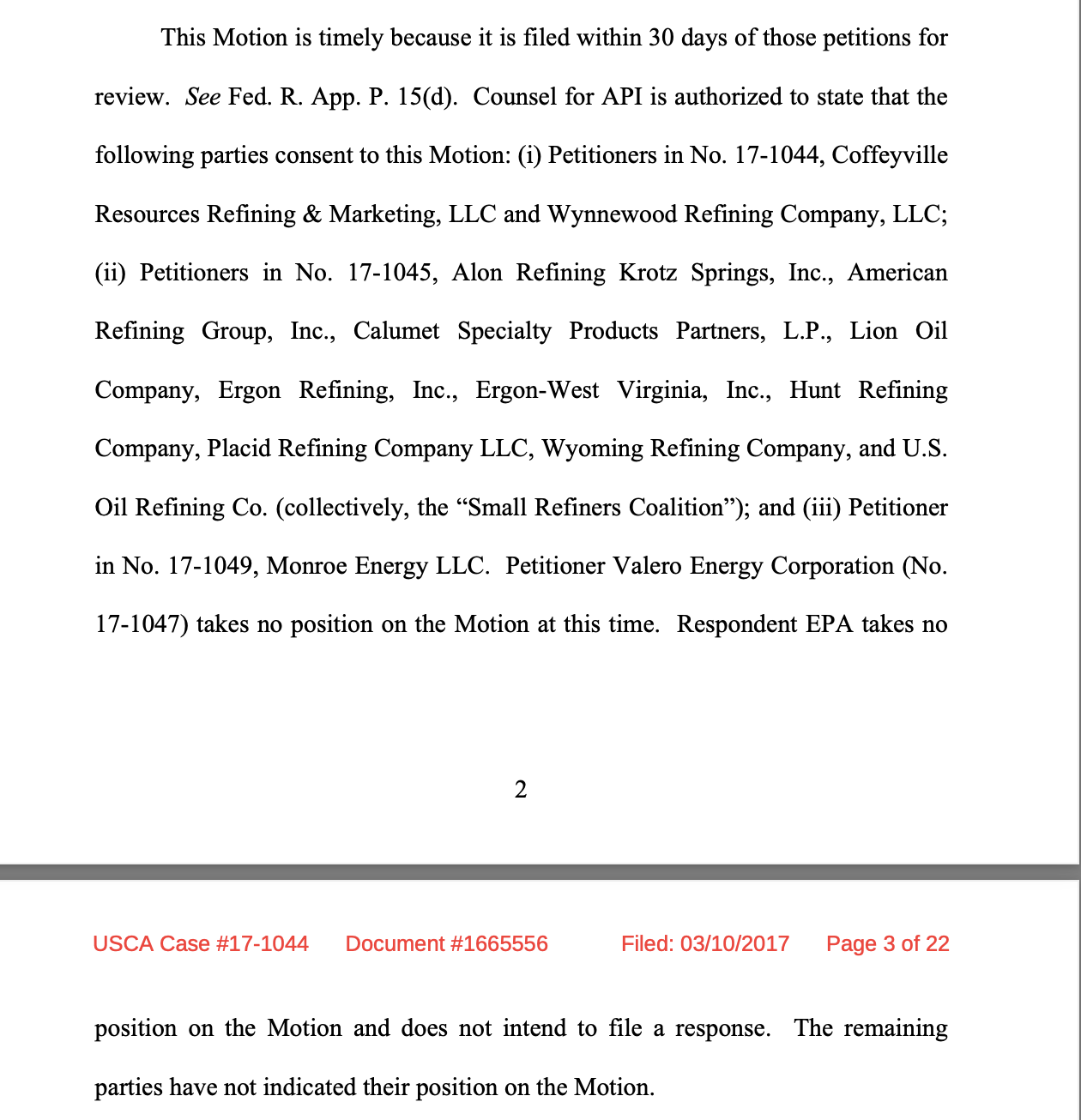
No parties opposed the intervention
8Analyzing the Opening Briefs
Looking at what happens after March 10, 2017:
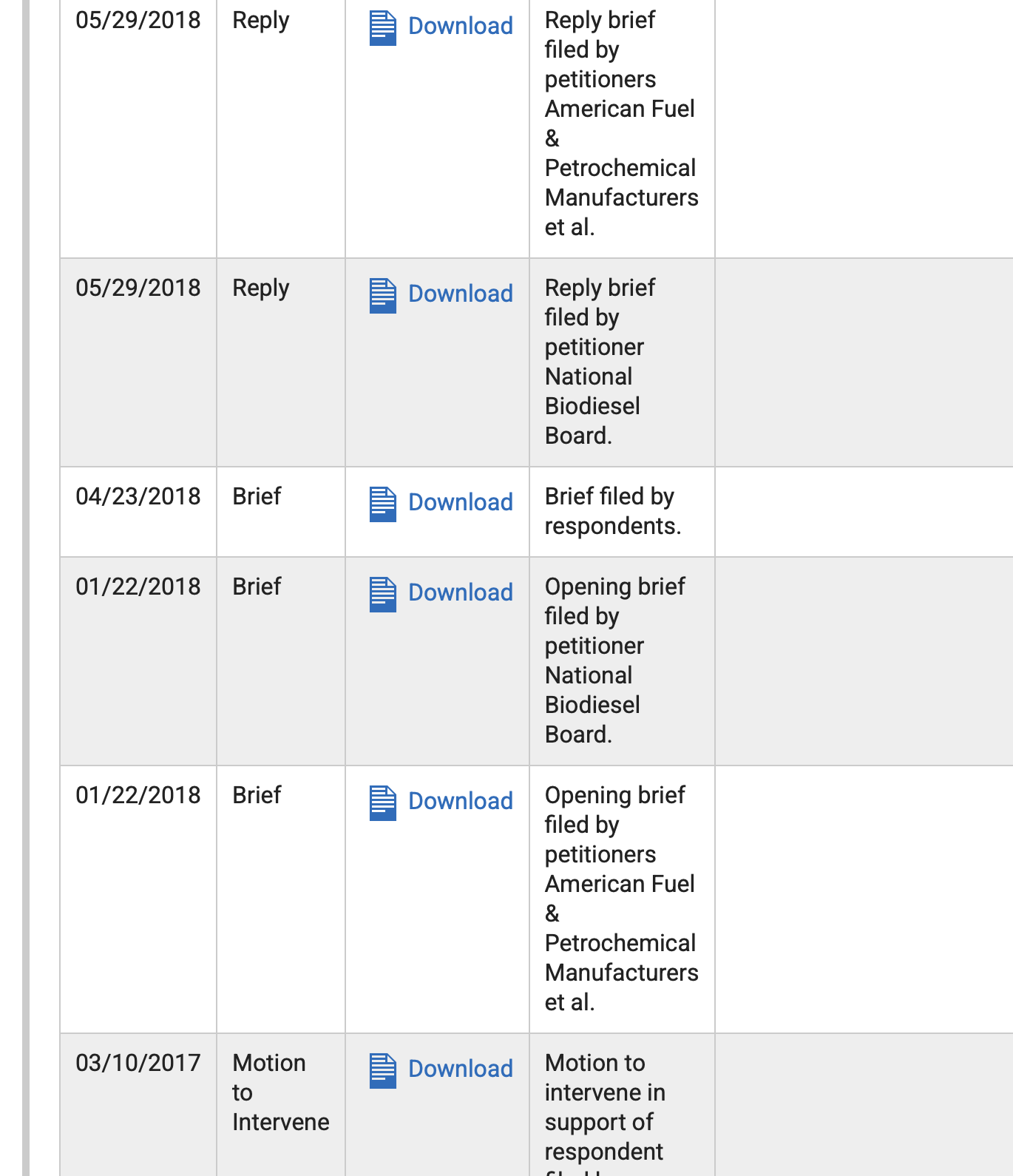
Opening briefs filed January 22, 2018
At the bottom of the screenshot, we see the last motion from API. After this, we finally see the opening briefs (from the petitioners) and the answering brief from the respondent.
First Opening Brief - Refiners Coalition
Let's look at the first brief filed by American Fuel & Petrochemical Manufacturers et al.:
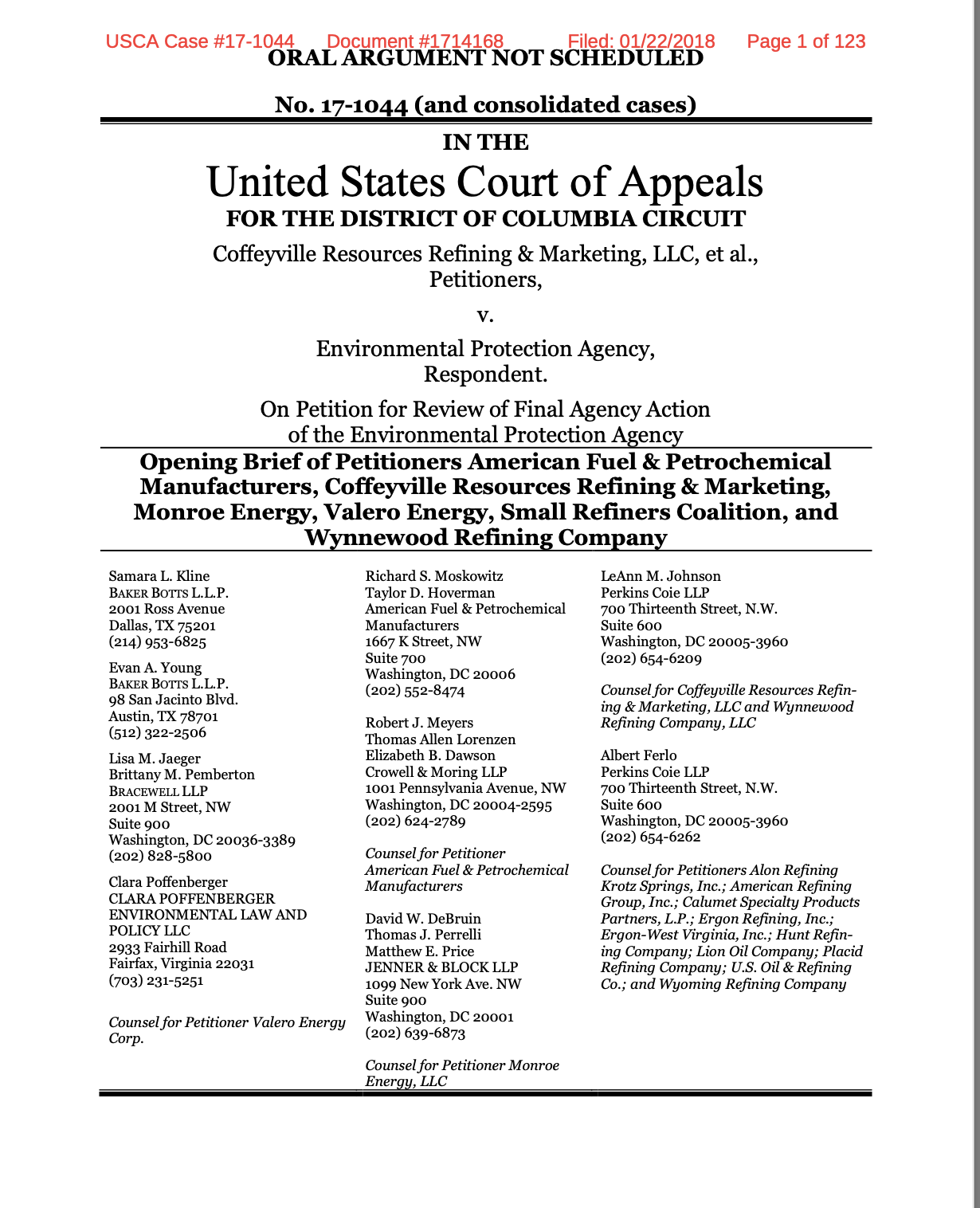
Opening brief cover page
On the first page, I can see who filed it:
- American Fuel & Petrochemical Manufacturers
- Coffeyville Resources Refining & Marketing
- Monroe Energy
- Valero Energy
- Small Refiners Coalition
- Wynnewood Refining Company
Even better, on page 2 I get:
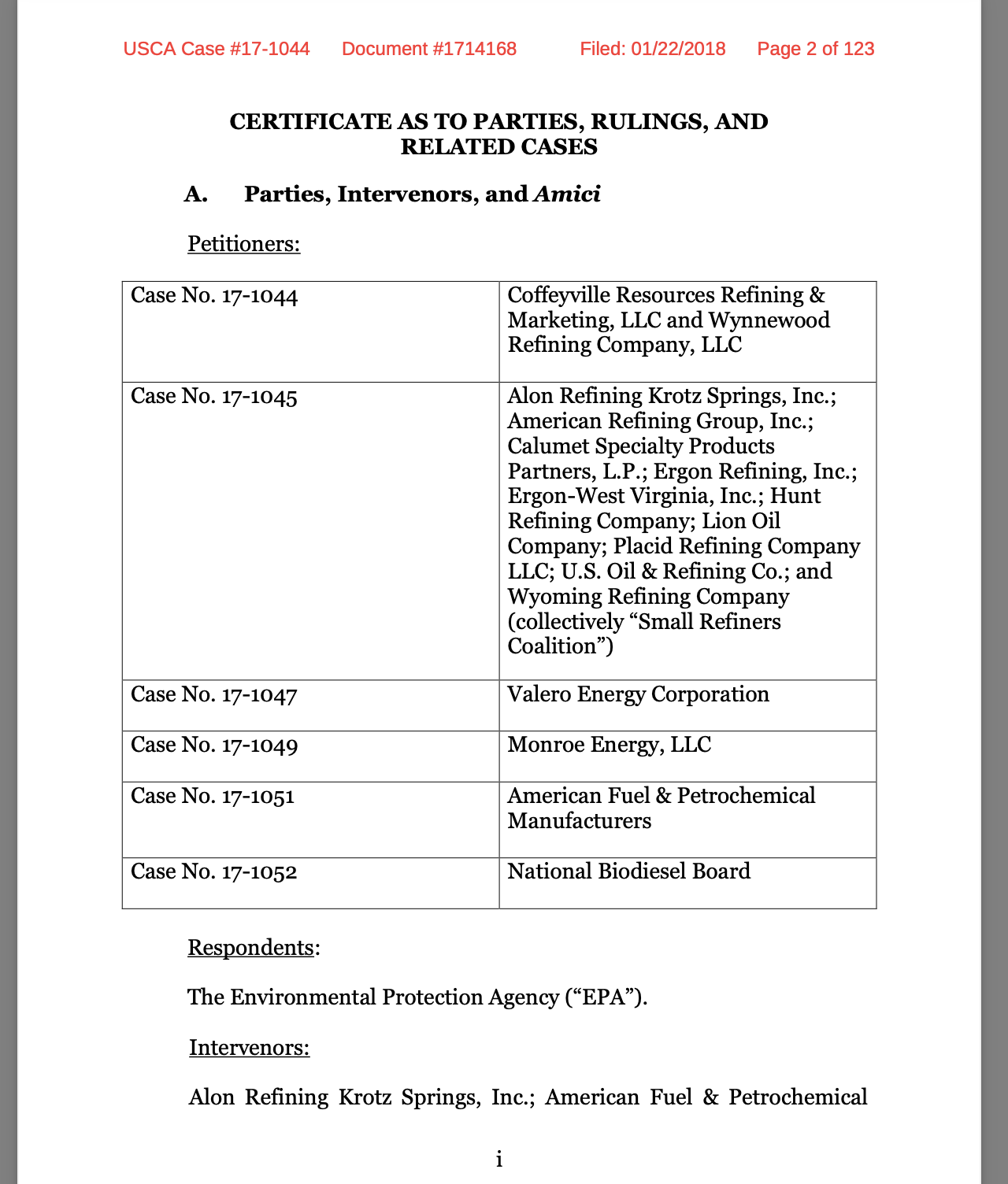
Detailed petitioner information with case numbers
I get the docket number for each petition for review! This helps a lot. The respondent is still EPA, but now we have intervenors:
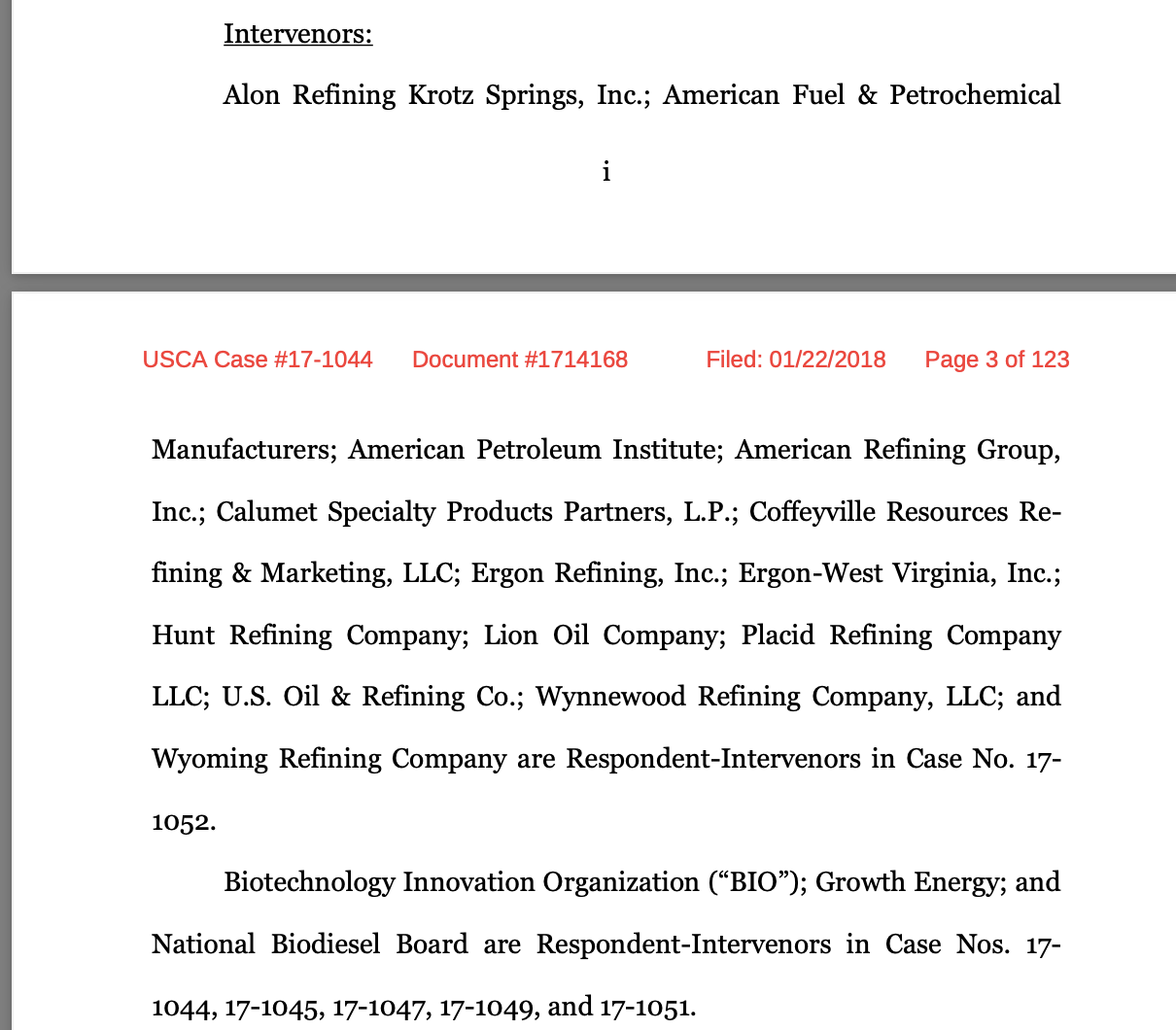
List of respondent-intervenors
And still no amici:
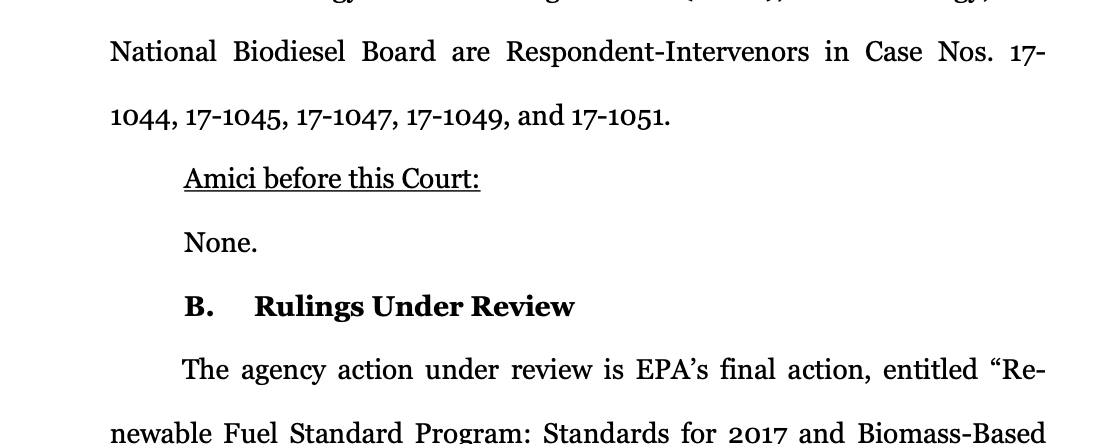
No amici curiae at this stage
Looking at the conclusion section on page 64:
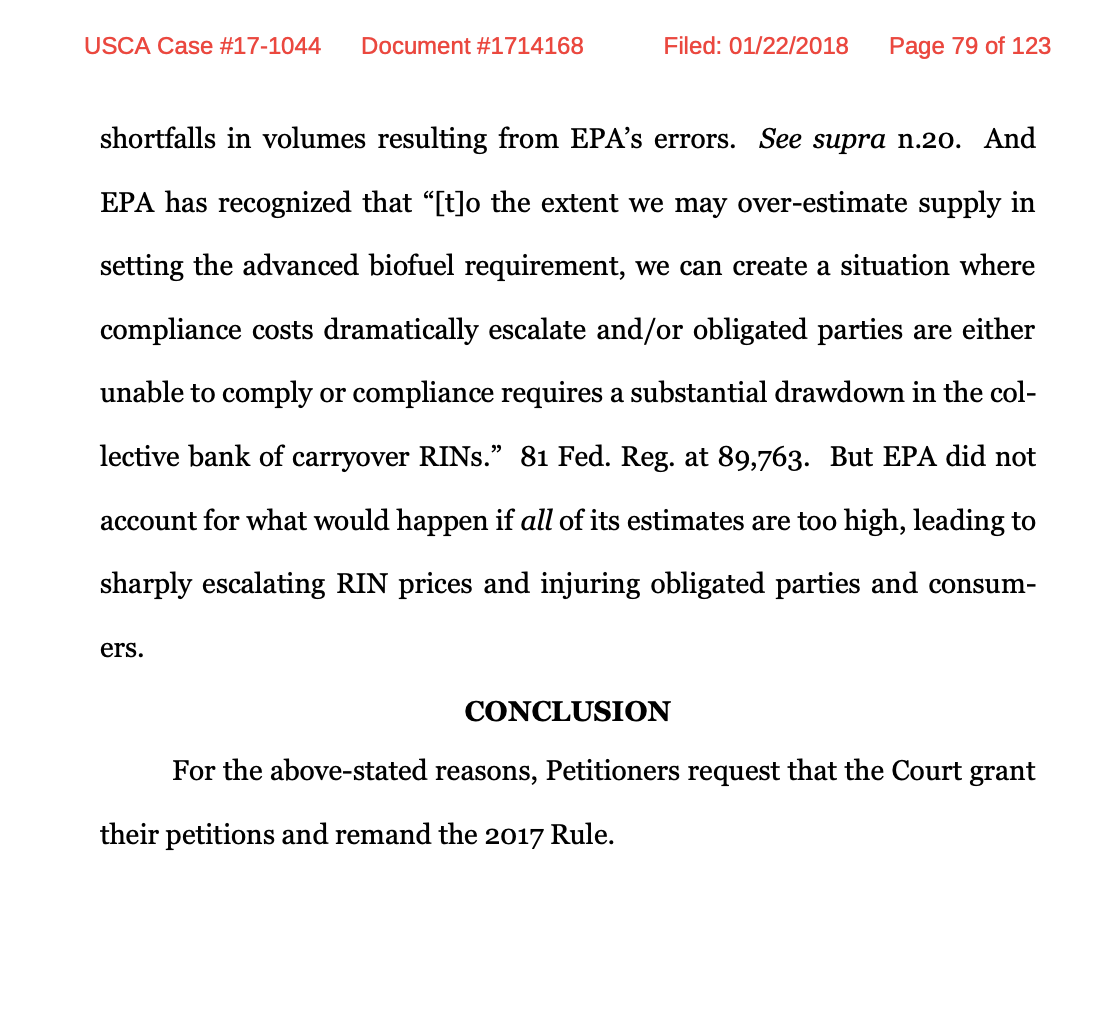
Petitioners want the court to grant petition and remand
The petitioners in this brief want the court to grant the petition for review and remand the 2017 rule to EPA.
Second Opening Brief - NBB
Now let's look at the other brief filed by NBB:
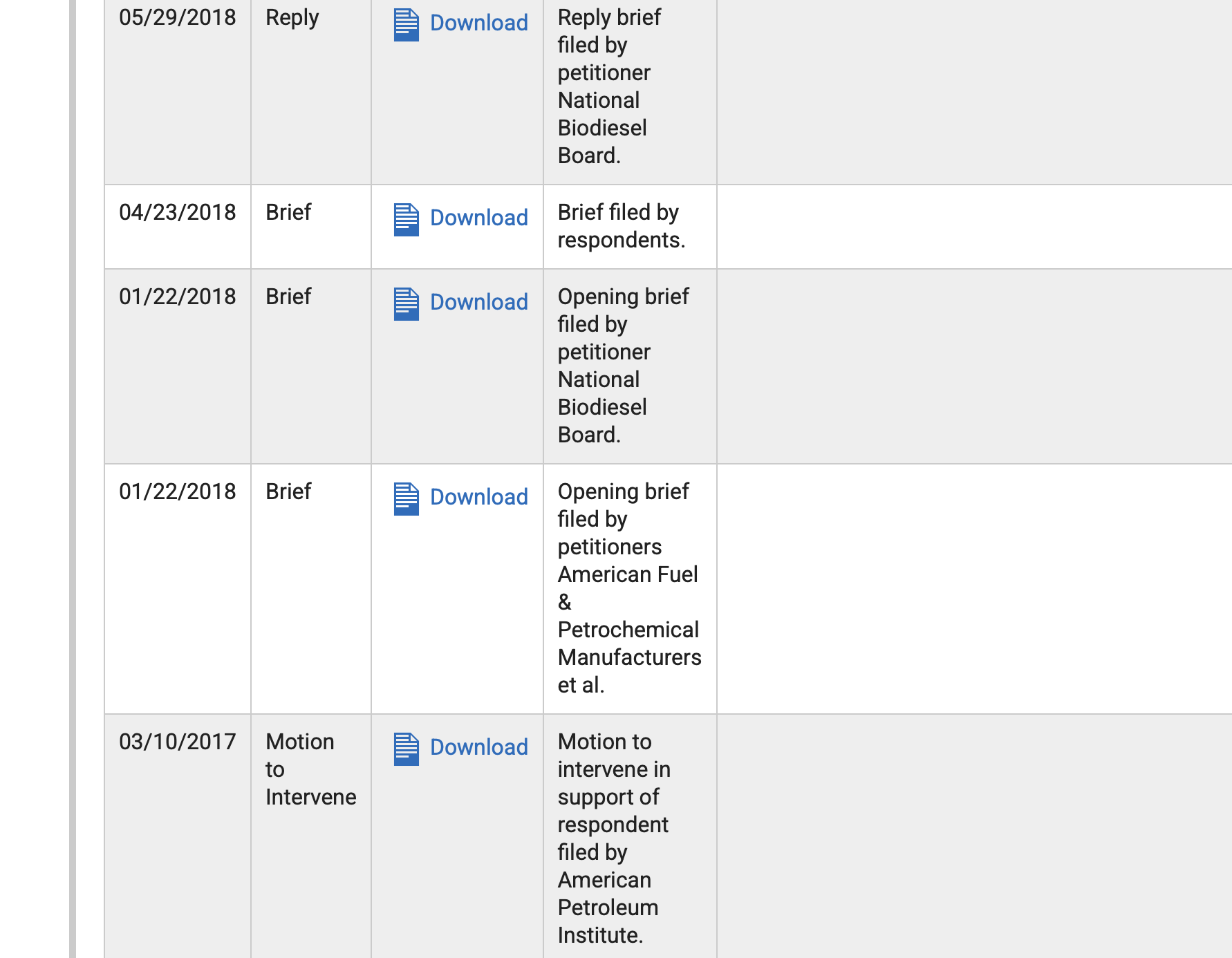
NBB's opening brief
It's filed on the same date as the other opening brief (normal - all opening briefs are generally due at the same time):
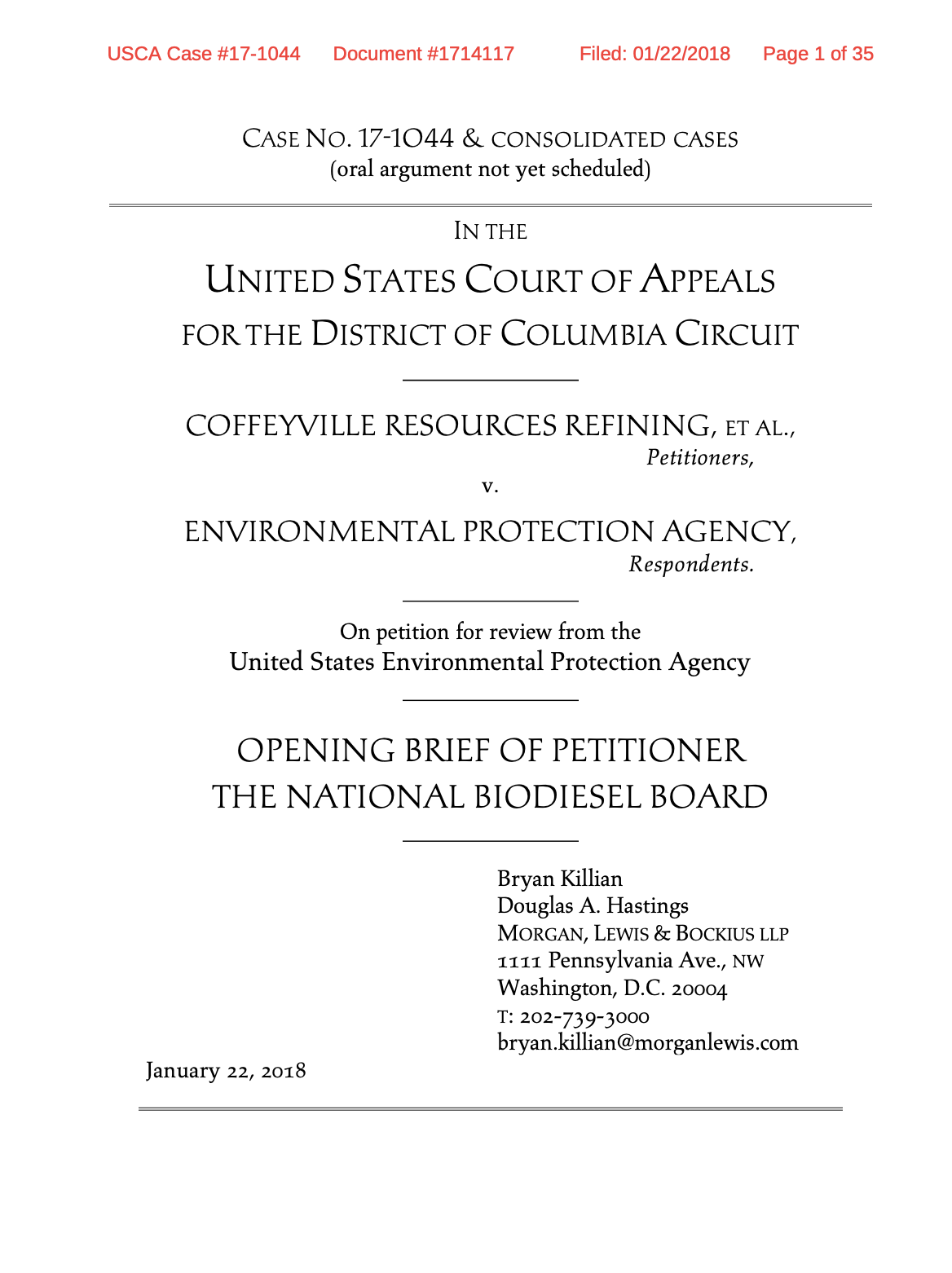
NBB brief cover page
The petition is only by NBB. I'm wondering: what happened to NBB's motion to intervene in support of EPA? Can they be a petitioner in support of respondent? Looking at the conclusion:
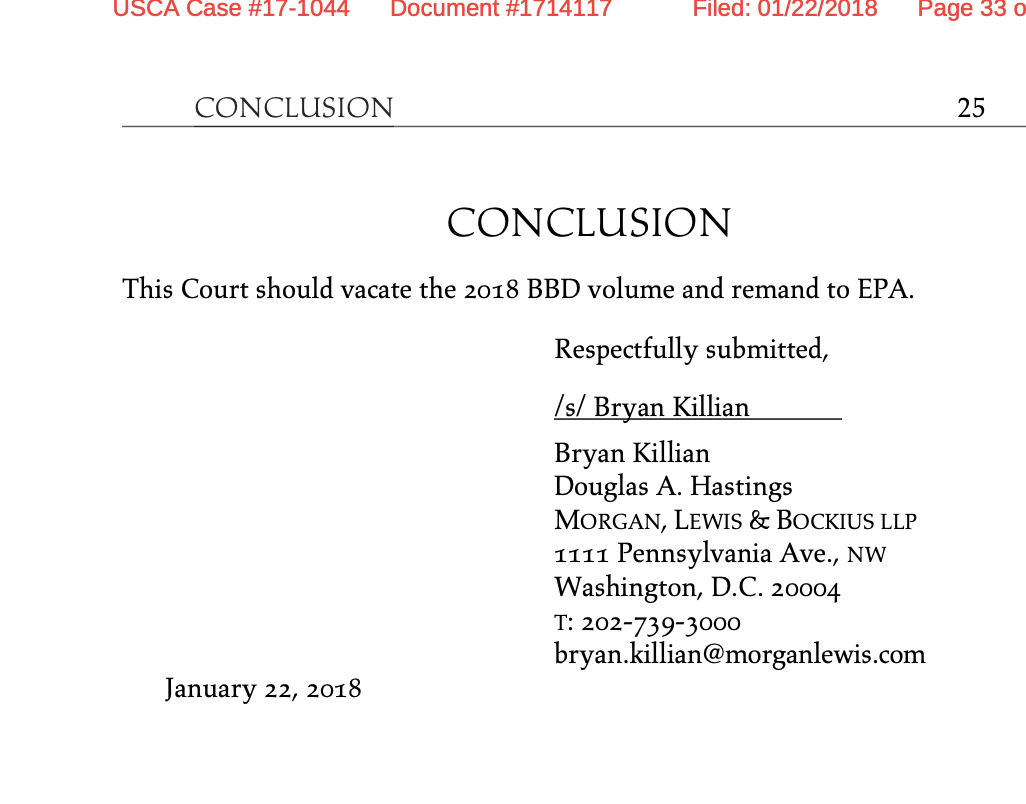
NBB's conclusion section
I wasn't entirely clear on what NBB wanted, so I used AI assistance (Claude/ChatGPT) to help clarify:
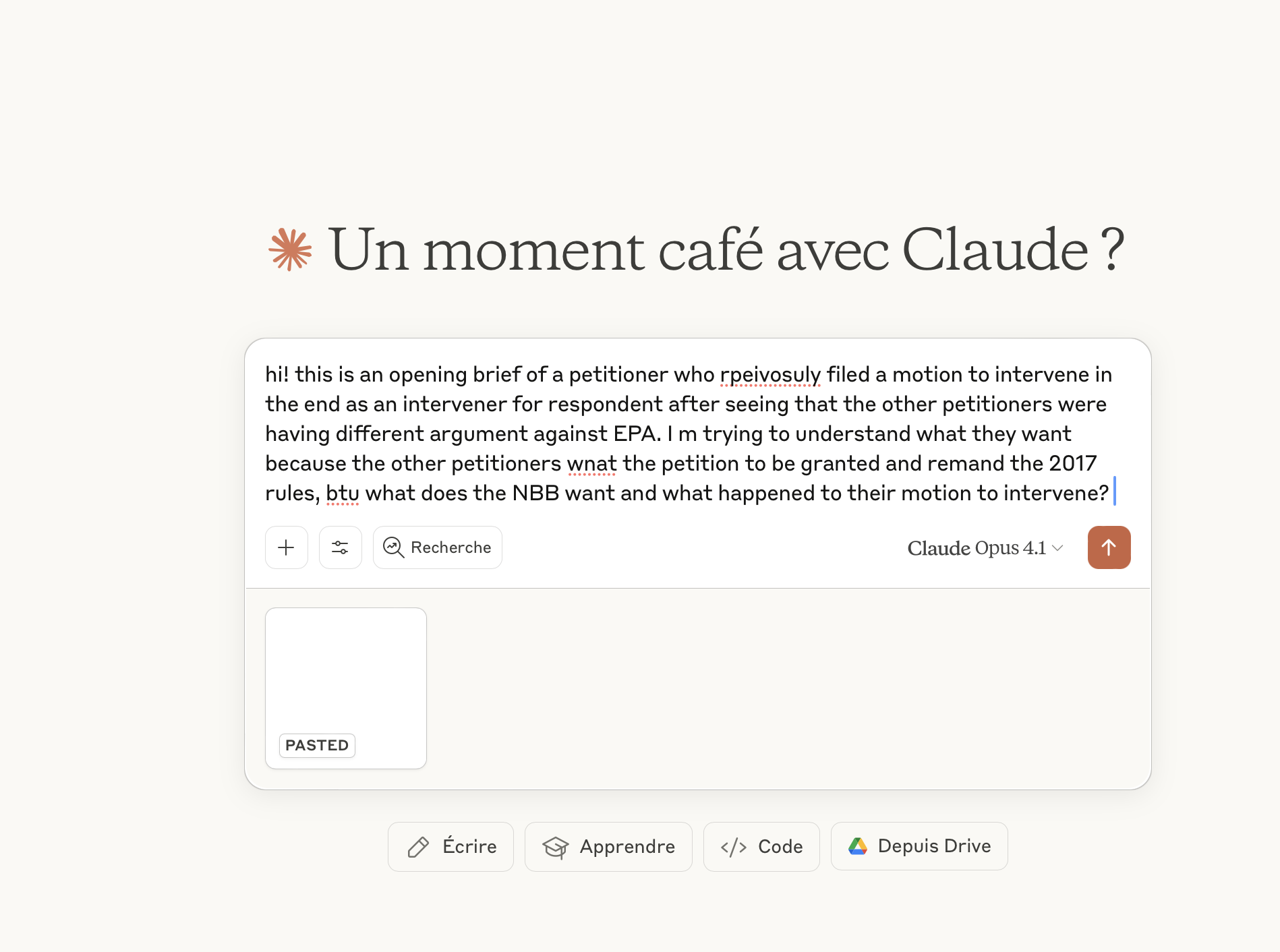
Asking for clarification on NBB's position
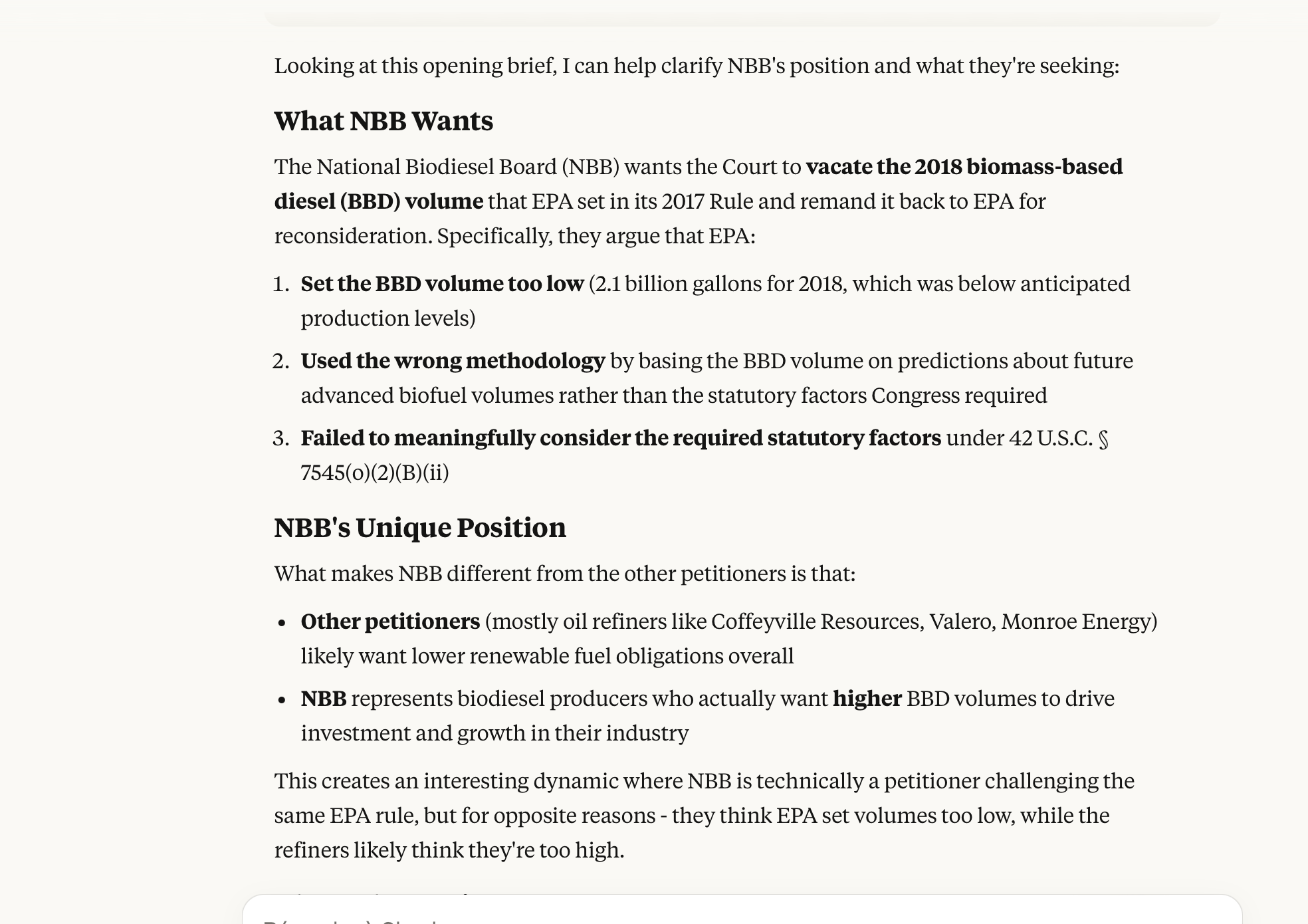
AI clarification of the opposing positions
- Refiners: Want LOWER renewable fuel obligations (economic concerns)
- NBB: Wants HIGHER biodiesel volumes (also economic reasons)
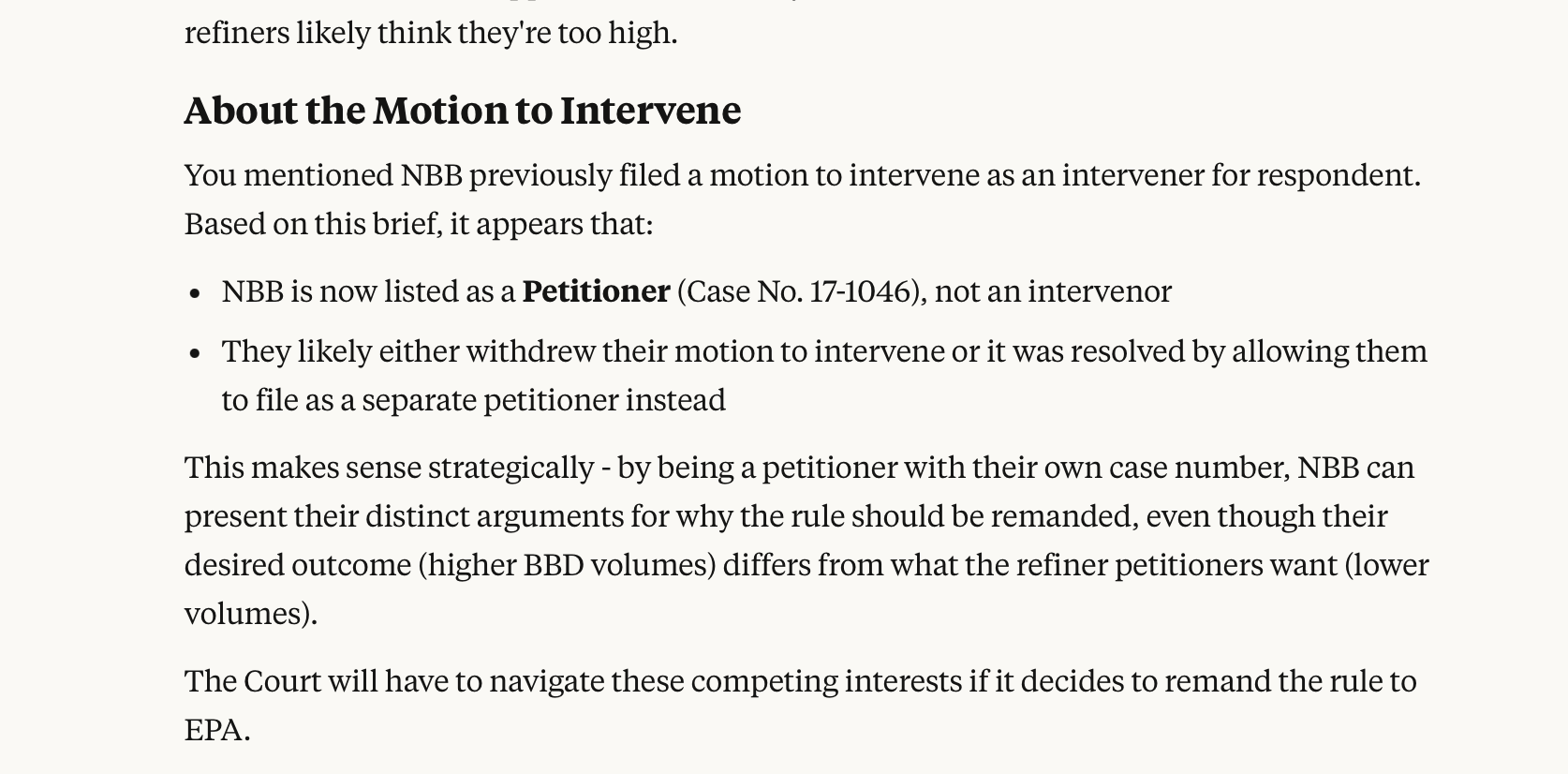
NBB allowed to file separate petition
I also asked for more information about what the refiners wanted:
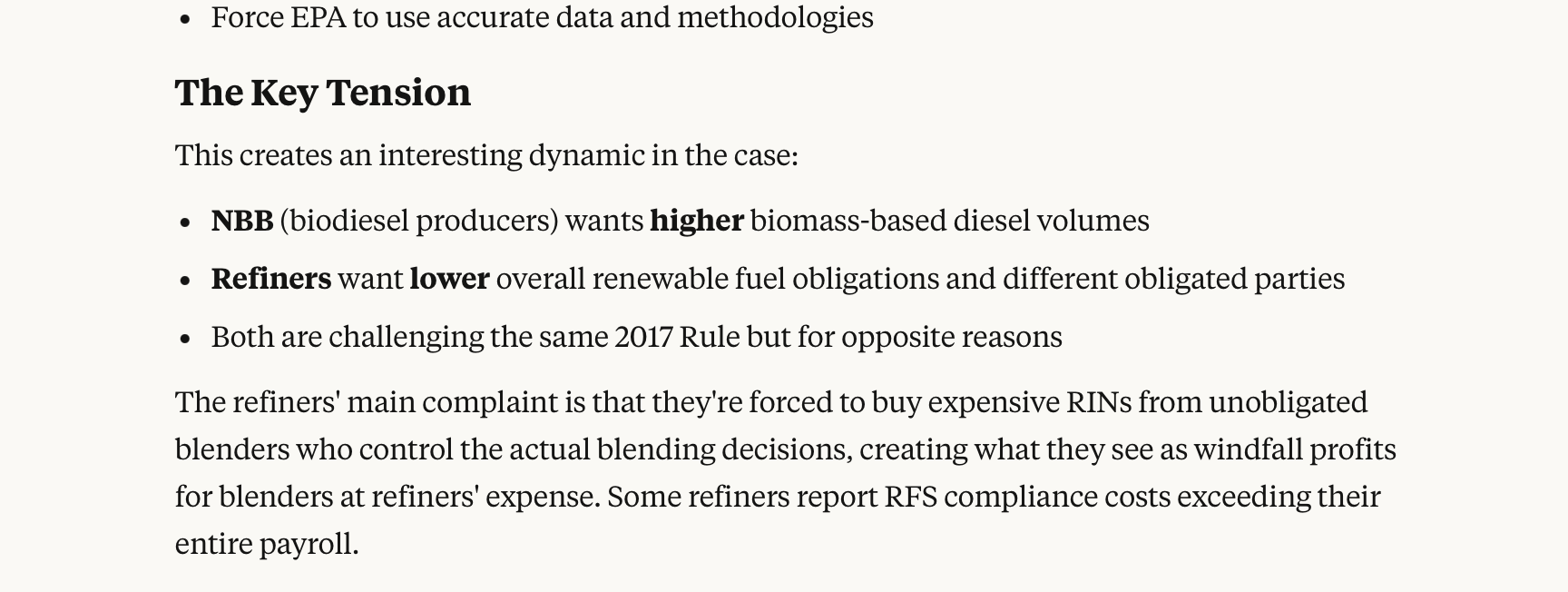
Clarification of refiners' position
9EPA's Answering Brief
After the NBB brief, we have a brief filed by respondents (EPA), three months later:
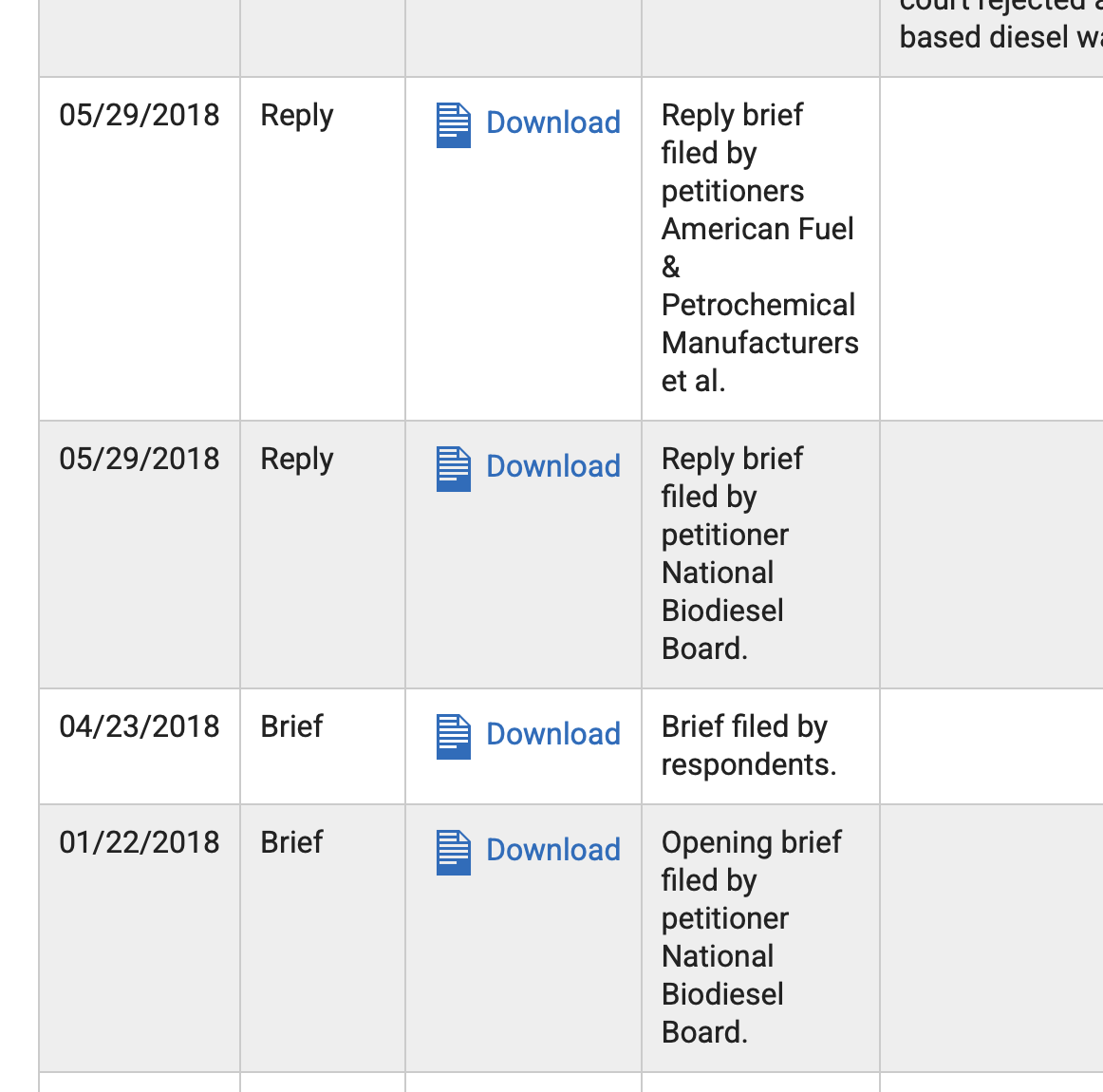
EPA's answering brief in the timeline
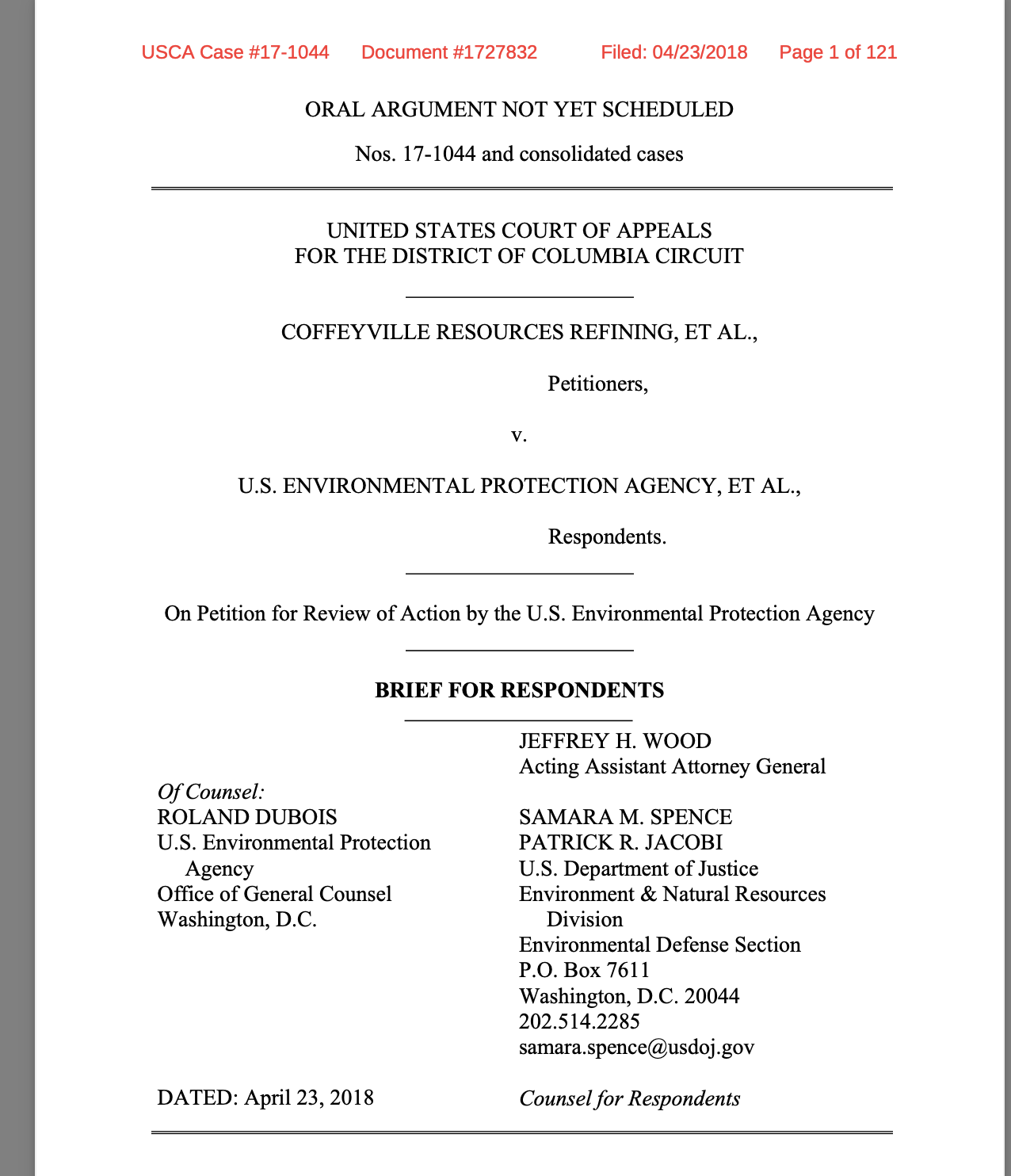
EPA's answering brief cover page
Looking at the table of contents:
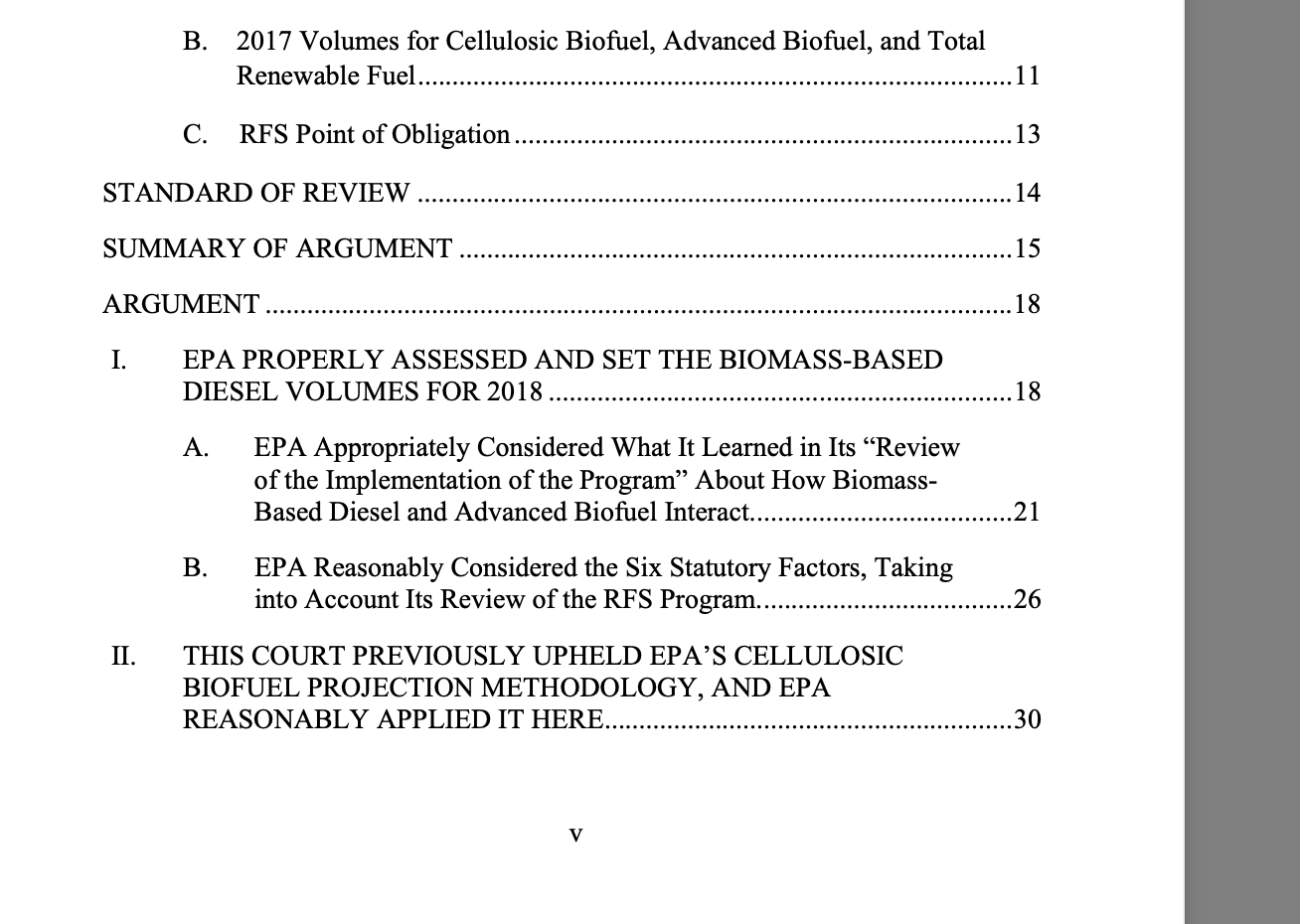
Table of contents - addressing NBB petition
Part 1 addresses the NBB petition, and:
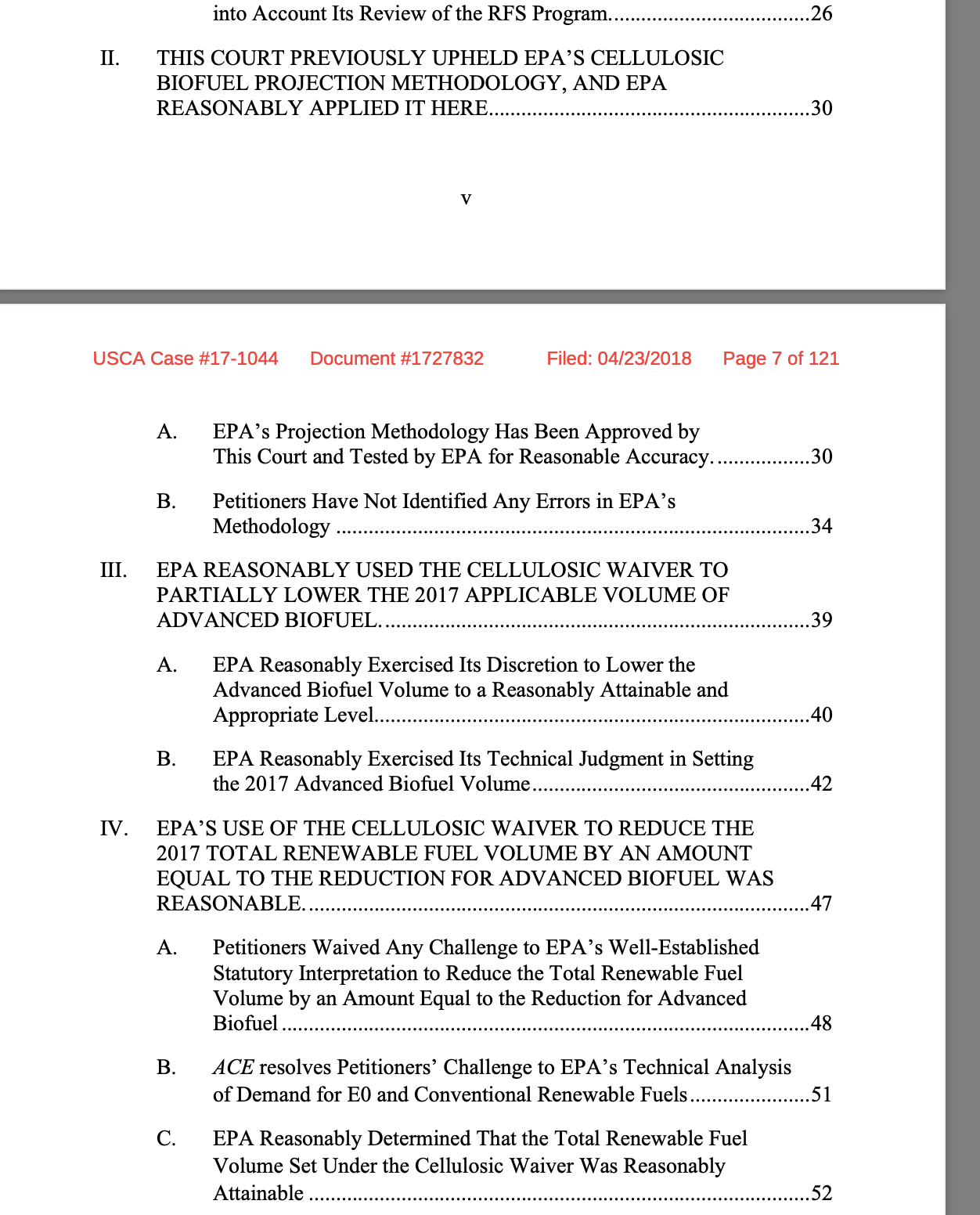
Table of contents - addressing refiners' arguments
The other sections address the opening briefs of the other petitioners (who wanted lower volumes).
I confirmed with AI assistance and reviewed the answering brief. EPA's position:
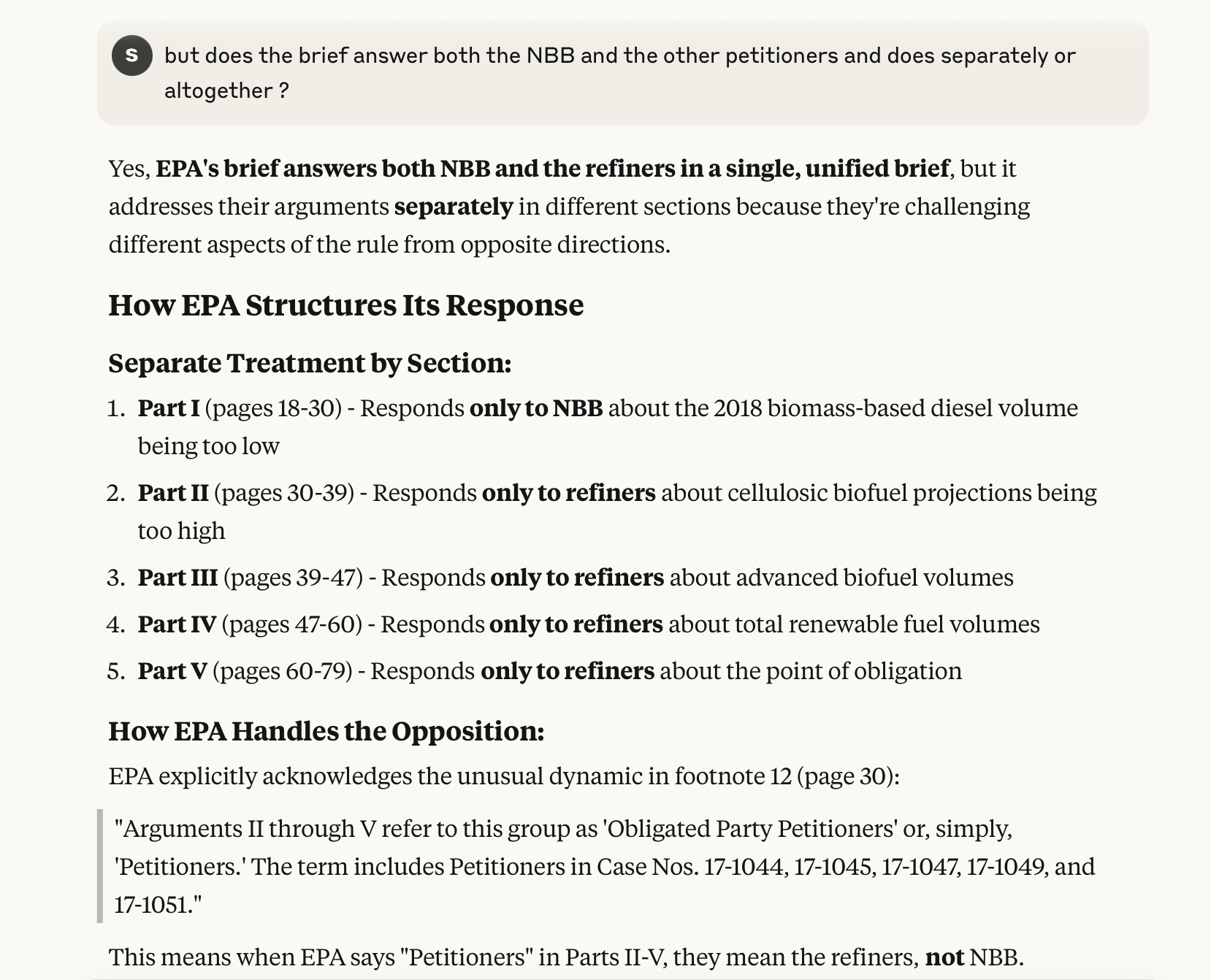
EPA's "Goldilocks" position
- Uphold the entire 2017 Rule as written
- Defer to EPA's technical expertise and policy judgments
- Reject both NBB's push for higher volumes AND refiners' push for lower volumes
- Find that many challenges are procedurally defective
10Reply Briefs
On the case URL, we see there's a reply brief from the American Fuel and Petrochemical Manufacturers (the coalition of refineries petitioners), which is likely an answer to EPA's answering brief:
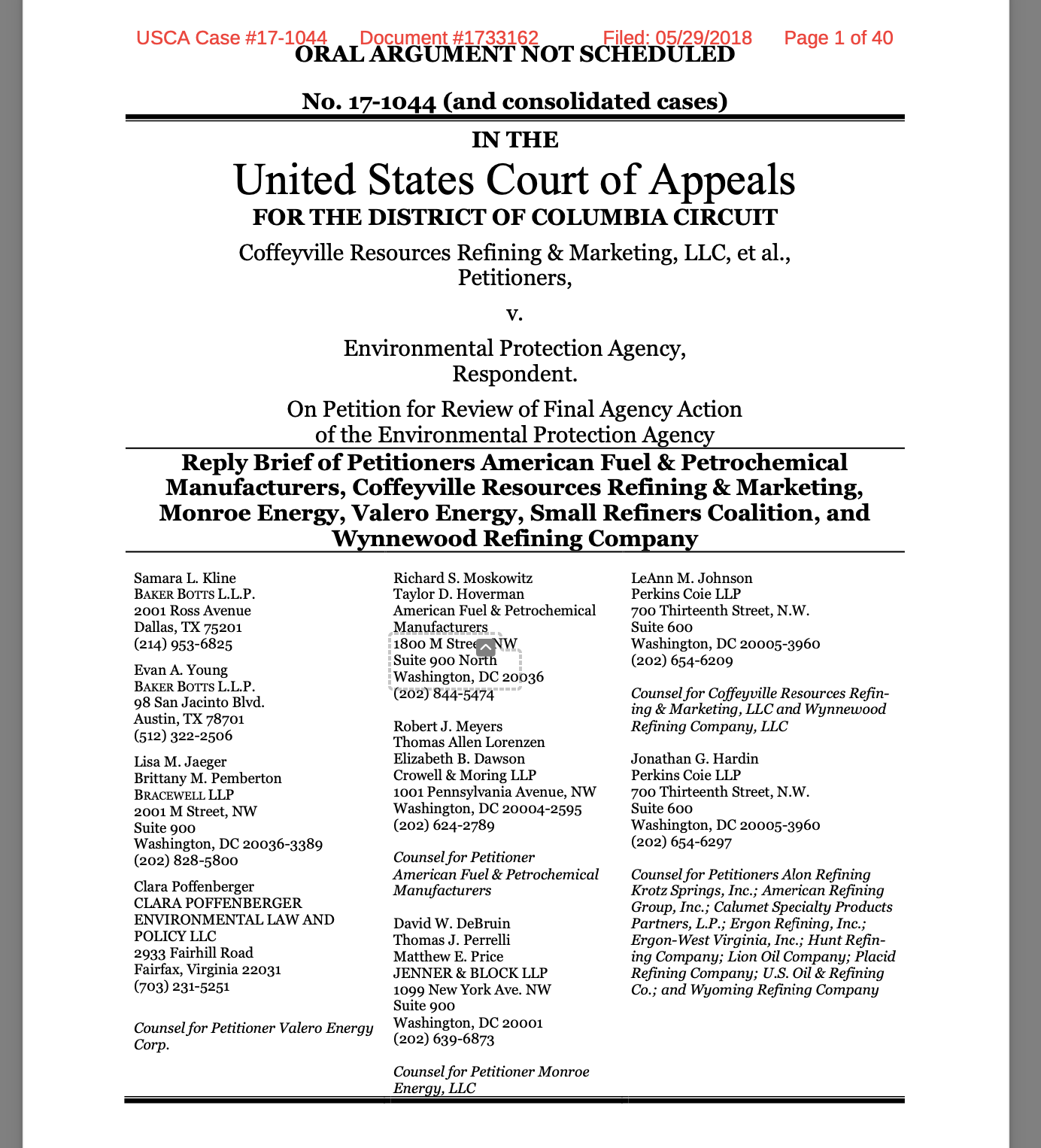
Refiners' reply brief
Looking at the table of contents:
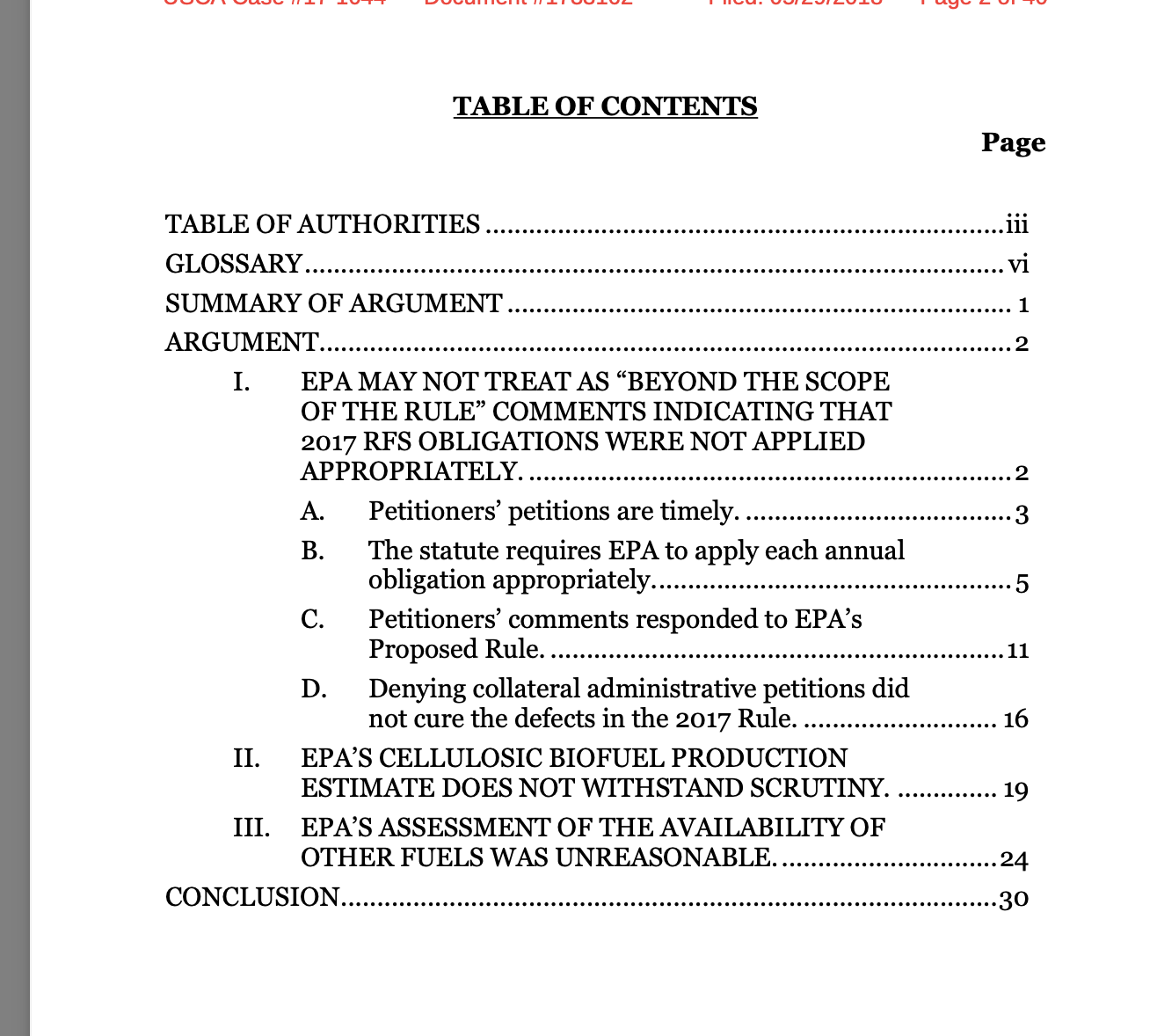
Reply brief table of contents
I'm checking whether it's only responding to EPA's answering brief or also to NBB's opening brief (which would be unusual). After reviewing with AI assistance and looking through the document, I can confirm the refiners petitioners are only replying to EPA, as seen in the table of contents and main text.
Reply brief addressing EPA arguments
11Final Steps and Court Opinion
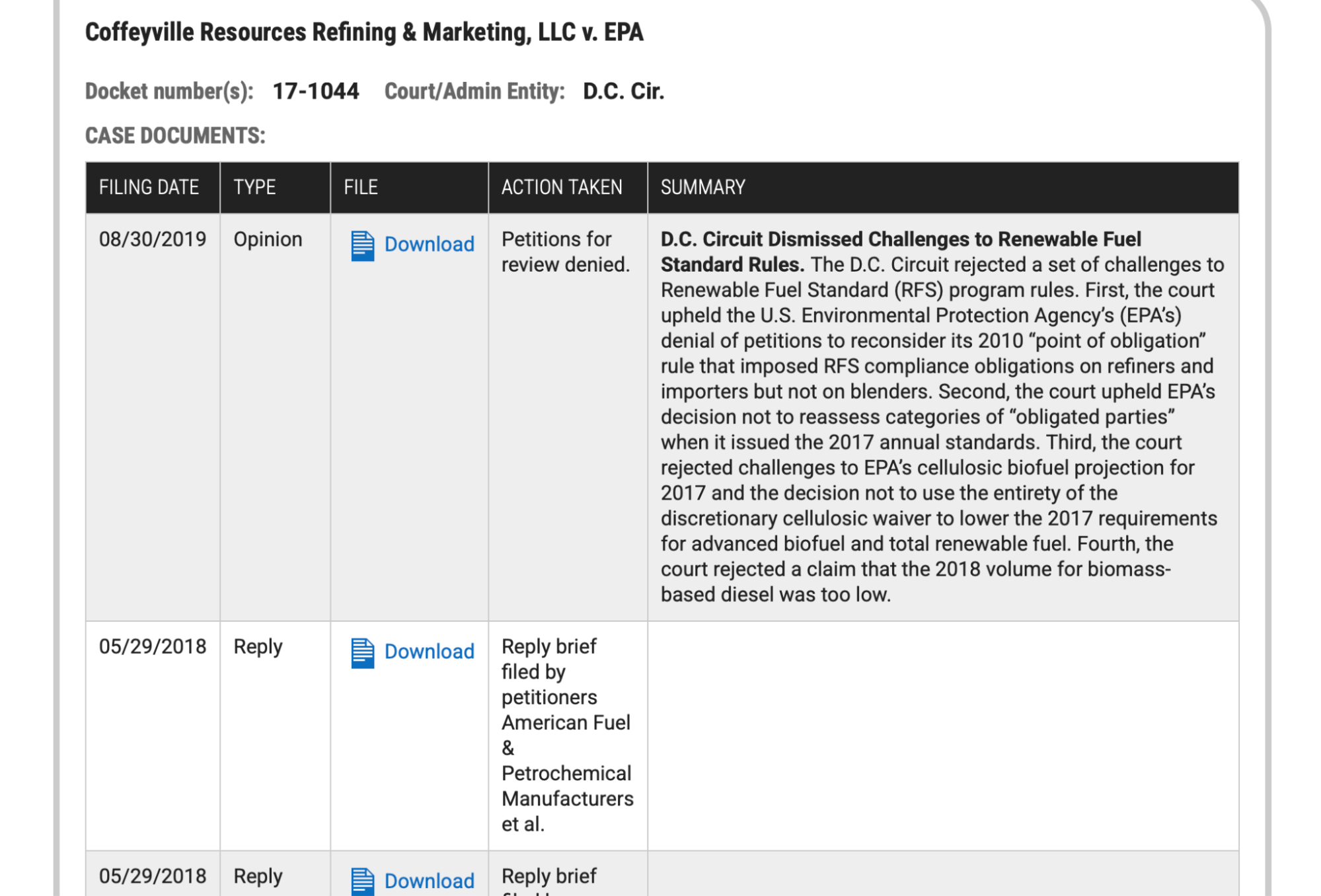
What's next? Looking at the case URL:
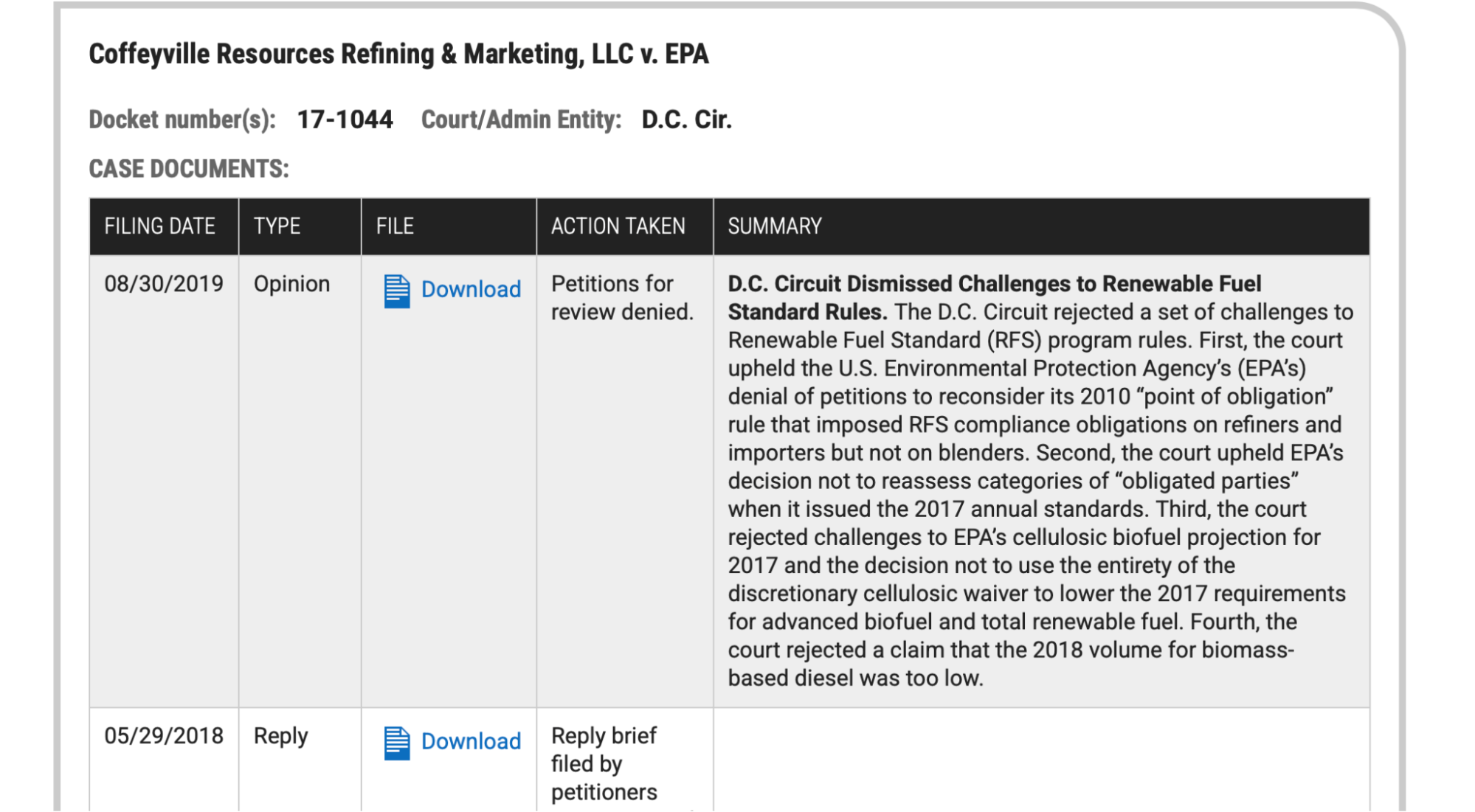
The court's opinion - final document
It's the opinion, so no need to code anything. We're (almost) done!
Cross-Checking with RECAP
Let's look at the RECAP docket sheet that was copy-pasted earlier:
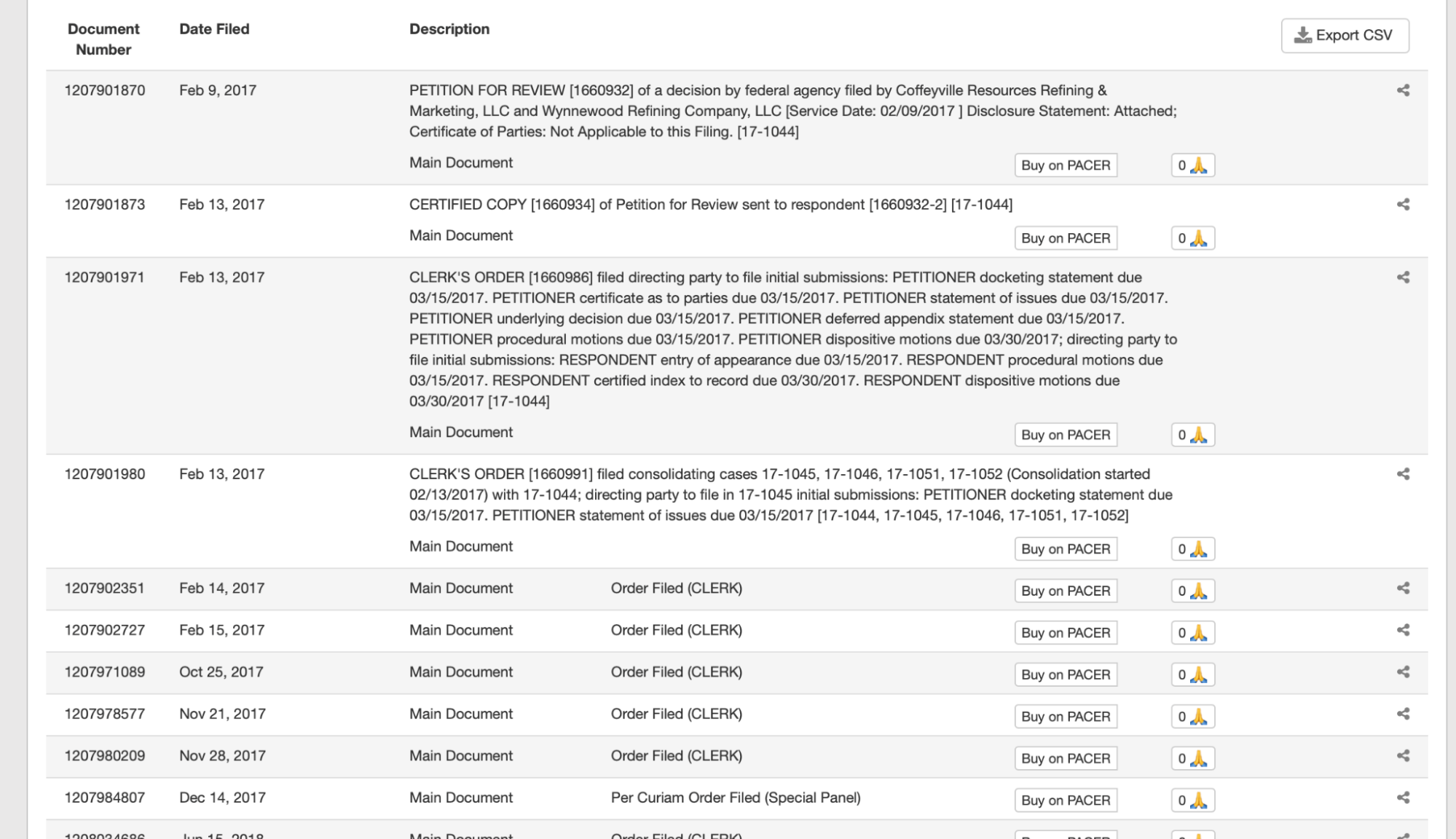
RECAP docket sheet for verification
Looking at my case profile, the dates are correct. The petition for review in the first row tells me when it was filed by the refiners. I can see on February 13 there's an order to direct parties to file initial submissions regarding docketing statement, statement of issues, and other procedural deadlines.
The same date, it says the clerk filed an order to consolidate cases together on February 13, 2017, with some more procedural deadlines.
And then:
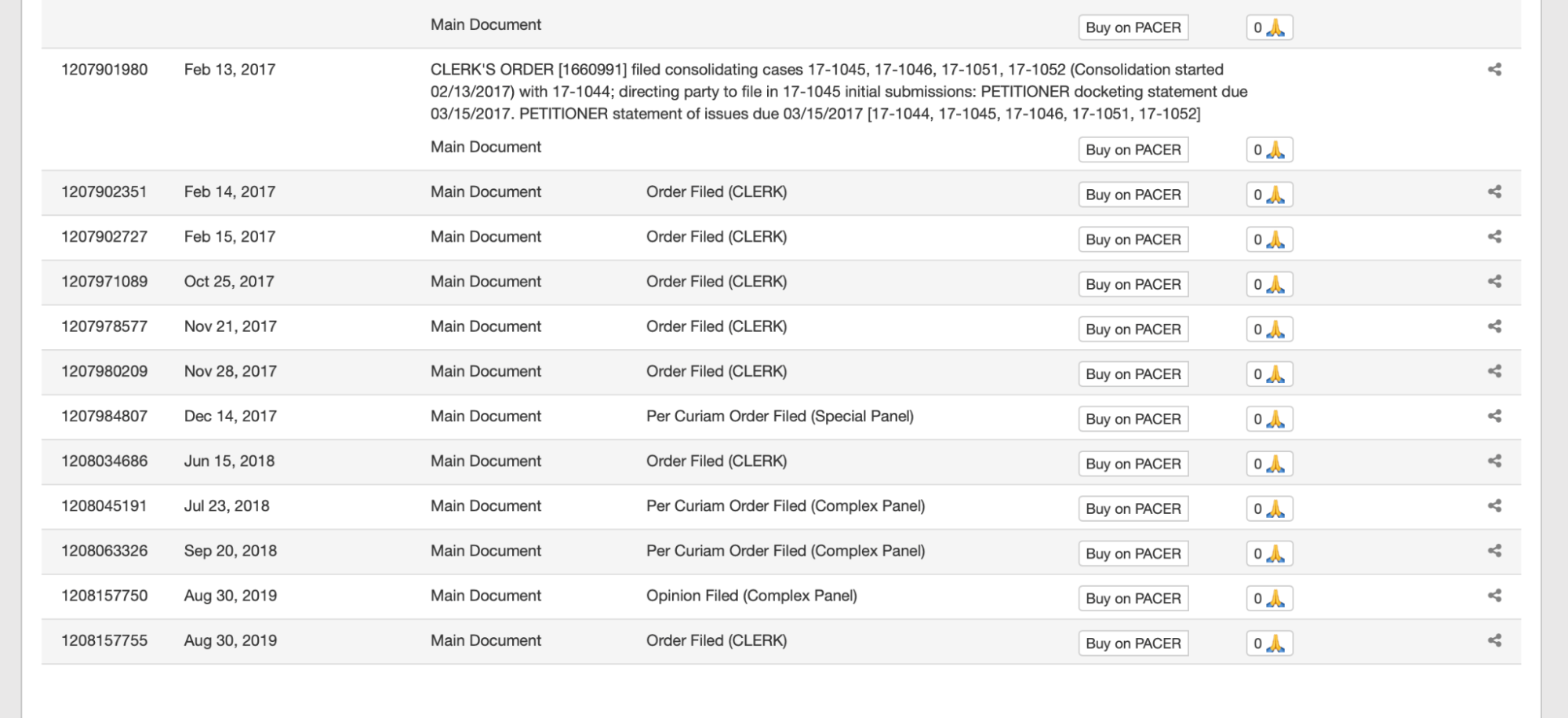
Long list of documents without descriptions
We only see a long list of documents without descriptions that we can't access. This is annoying but we can't do much more for now.
Filling in Missing Petitioner Information
I realize I put placeholders for each individual petitioner's petition for review before they got consolidated. Let me go back to the case URL to check if this information is available:
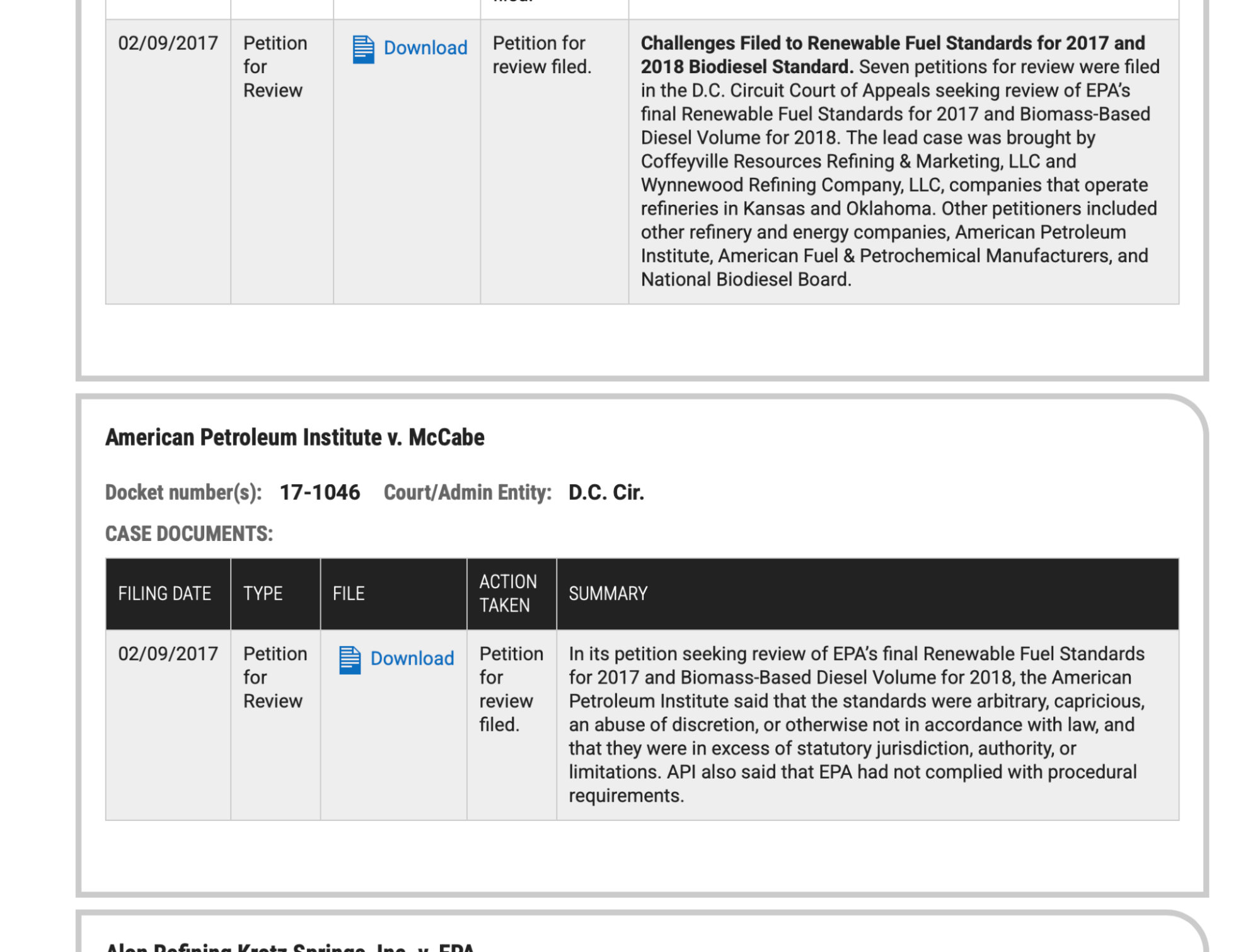
Finding individual petition details
Under the petition for review from February 9, I can see the docket number. Remember, we found explanations in documents about which petitioner filed which original petition. By scrolling down on the Sabin Center page, you can find all of them.
Final Complete Case Profile
Key Takeaways
- Always verify your case: Don't trust the first search result - check dates, parties, and docket numbers
- Build incrementally: Start with placeholders and fill in details as you discover them
- Cross-reference sources: Use multiple databases (RECAP, Sabin Center, etc.) to get complete information
- Document everything: Keep track of dates, parties, and their positions throughout the case
- Use AI tools wisely: When legal arguments are complex, AI can help clarify positions and relationships
- Expect incompleteness: Legal databases often have gaps - work with what you have
- Look for inferences: Sometimes you can deduce what happened (like denied motions) from later events